Sold as a Slasher
Four young faces hang above a dripping red title on the cover of Campfire Tales, and under them a man with a hook stands in a blue wood with a fire at his feet. "Deep in the woods, no one can hear you scream," it says, which is selling a slasher, and the film isn't one. It went straight to video in Britain in May 1997, the year I first saw it. America nearly got something bigger: after Scream, Paramount came close to putting it on 2,000 screens, and when that fell through it arrived there on VHS in September 1998, with promotional material comparing it to Scream and I Know What You Did Last Summer, though it had been conceived before both.
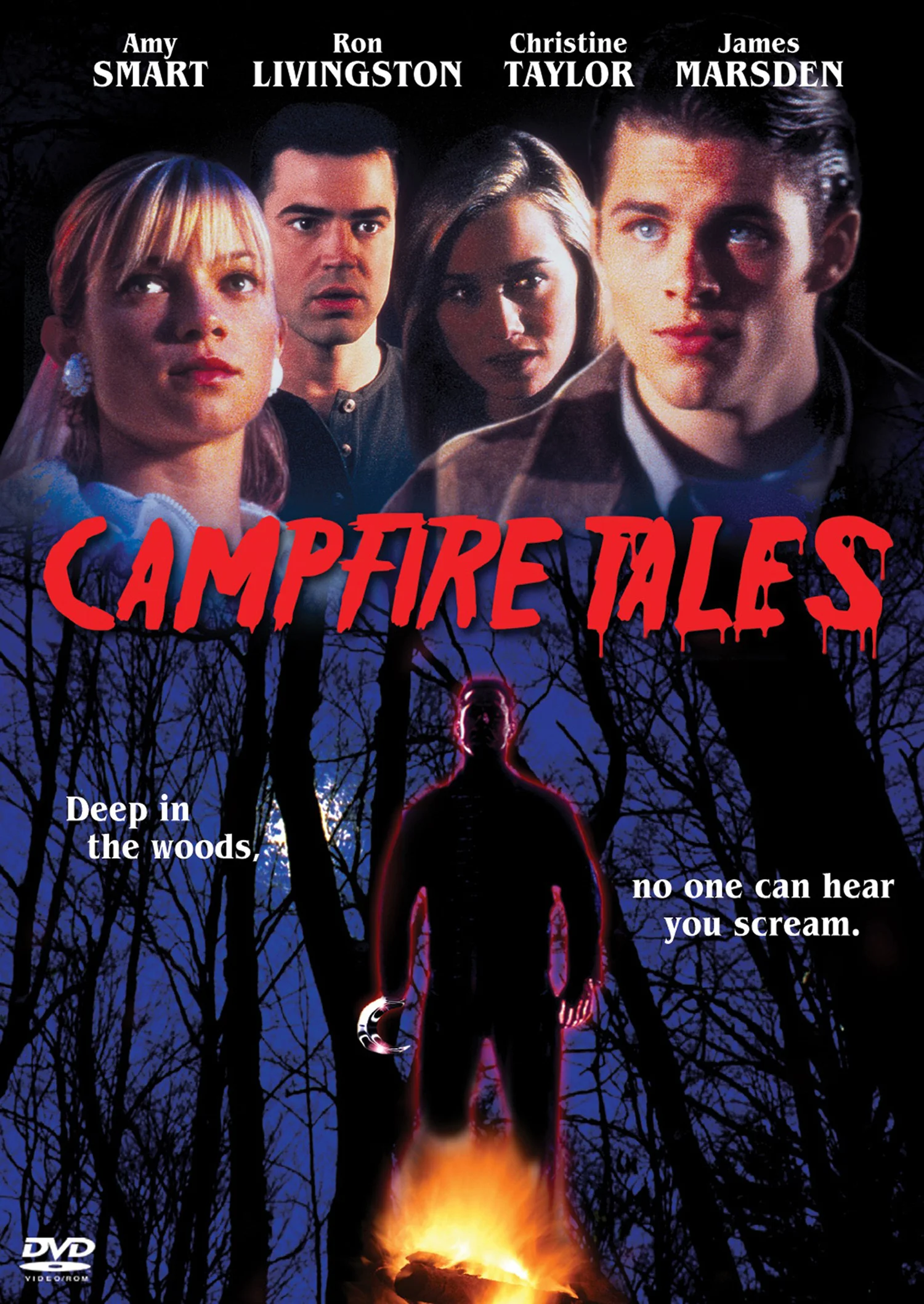
The frame is simple. A group of friends are stranded in the woods after a car accident and trade stories round a fire while they wait for help, and every story is an urban legend most of the audience already knows. Martin Kunert, Eric Manes and Matt Cooper wrote it knowing that, and they understood that a legend is built around one scare, so they don't pad them. "The Hook" gives Amy Smart and James Marsden the parked-car story in its oldest form, where the bloody hook left on the door is the whole payoff. "The Honeymoon" traps Ron Livingston and his new wife in an RV with a monster outside, and "The Locket" sends a drifter to a lonely farmhouse where a mute woman, Jacinda Barrett in her first film, lets him stay the night.
"People Can Lick Too" is the segment I'd show anyone who doubts the writing. It takes the legend of the girl who reaches down in the dark to her dog and finds it isn't the dog, and moves it onto the internet, with a girl chatting online to a stranger the audience knows almost at once is a killer. Jonathan Fuller plays him without a line of dialogue, and we barely see him beyond a man typing in a dark room. The whole segment runs on the gap between what she can see on her screen and what we can see on ours. The Rentals' "Waiting" is on its soundtrack too, which dates it better than any computer could.
Very few people die, and Steve O'Brien complained in SFX magazine in June 1997 that "so few of these loathsome kids actually die." That's the point, though. The tales keep their violence small so the frame story has somewhere left to go. Empire said the final twist "isn't unprecedented," and it isn't. I'd seen every one of the Amicus portmanteau films from the seventies, Tales from the Crypt and Asylum among them, so I knew the family this ending came from, and it still made an impression on me.
Sources:
-
Campfire Tales (1997 film) — Wikipedia
-
Campfire Tales is a Great Anthology That No One Remembers — Wicked Horror
-
If You Love Urban Legends, You Need To Check Out This Forgotten Post-'Scream' Anthology Horror Movie — Collider
-
Campfire Tales Review — Empire
-
Campfire Tales (1997) — Horror Movie A Day
-
Horror Anthology Review: "Campfire Tales" (1997) — Slasher Studios
-
Amicus Productions — Wikipedia
Filed under Film & TV
This post is timestamped using Blockchain technology. Verify