The Lighthouse Refuses to Explain Itself
Robert Eggers built a 70-foot lighthouse in Nova Scotia, shot on Kodak Double-X 5222 (the same film stock used for Raging Bull), and directed two grown men screaming at each other about flatulence. The result is one of the best horror films of the last decade.
The Lighthouse traps Robert Pattinson and Willem Dafoe on a rock in the North Atlantic as two keepers descending into madness. Or maybe just one of them. The film doesn't clarify, and that refusal is its greatest strength.
Eggers has a specific talent for historical claustrophobia. His Nosferatu remake proved he could scale production design without losing the dread. But The Lighthouse works because it refuses to scale. The 1.19:1 aspect ratio, nearly square and tighter than old Academy, started as a joke from cinematographer Jarin Blaschke: "If 1.33 is confining, this will really give you what you're after." Eggers took him seriously. The frame squeezes everything into vertical compositions. Walls, the tower, two men stacked on top of each other. The poster captures it: two faces pressed into a column of grey, nowhere to look but up.
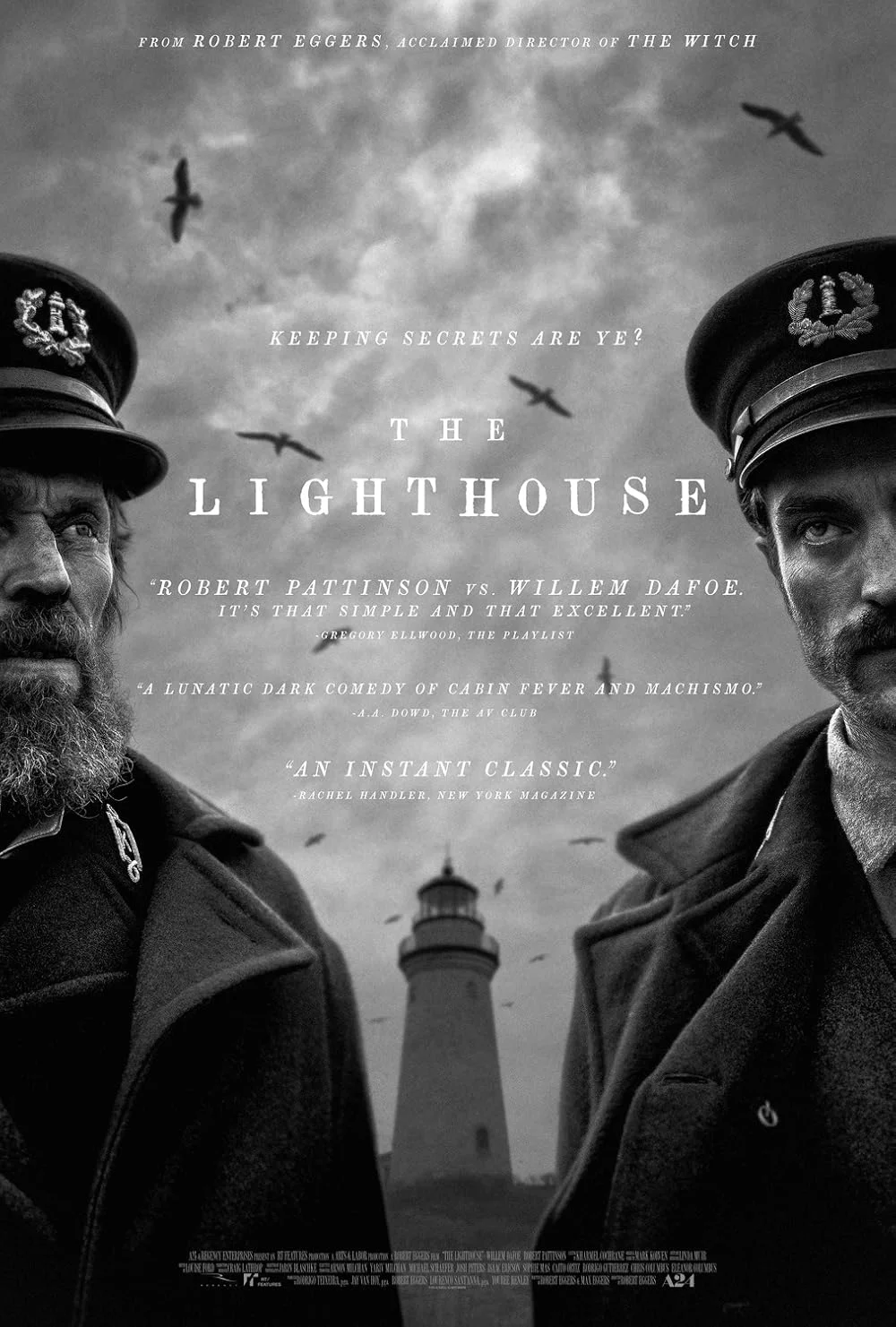
Blaschke earned an Oscar nomination for this, and it's deserved. He sourced 1930s lenses from Panavision's archive and collaborated with Schneider Optics on a custom orthochromatic filter that renders skin with the harshness of early photography. Dafoe's face looks like a geological formation. Pattinson's looks like it's decomposing in real time. The whole setup required nearly twenty times more light than The Witch, which Eggers shot digitally on an Alexa. Worth it.
Dafoe's account of the shoot is revealing. Camera positions were locked before the actors arrived. One chance per setup, no coverage. Pattinson refused to rehearse anything before cameras rolled. Dafoe, a Wooster Group veteran, wanted structured preparation. They barely spoke off-set. The tension wasn't manufactured.
The mythology runs deep. Prometheus reaching for forbidden light, Proteus shifting beneath the waves, the seabird curse pulled straight from Coleridge. Eggers drew dialect from Melville and Sarah Orne Jewett. But the film never stops to explain its references the way lesser genre work explains its monsters. It has the same refusal I admire in Enys Men, where isolation becomes its own grammar. The difference is two people bouncing the madness between them, and their combined instability hits harder than any lone figure staring at lichen.
The loose inspiration was the Smalls Lighthouse tragedy from early-1800s Wales, where two keepers named Thomas were stranded and one went mad watching the other's corpse decompose. Eggers has said the connection is "so loose that it's hard to impress how loose." The Lighthouse takes a true story, strips it for parts, and builds something closer to a hallucination than a narrative. I don't think it has a clean reading. I don't think it's supposed to.
Sources
-
Exploring the Stunning Black and White Cinematography of 'The Lighthouse' - No Film School
-
Willem Dafoe Talks Robert Pattinson, Farts and Eating Dirt - Den of Geek
-
The Myths and Archetypes Behind The Lighthouse Explained - Den of Geek
Filed under Film & TV
This post is timestamped using Blockchain technology. Verify