Never, Ever Sick at Sea
Castle Rock had been sitting on Malice since the company was founded in 1987, back when it was called Damages. When the studio wanted a fresh script it went to William Goldman, who was busy and proposed a young writer he was mentoring instead. That is how Aaron Sorkin came to the picture, delivering two drafts before breaking off to adapt A Few Good Men and returning for the rewrites that got Alec Baldwin to sign. Scott Frank was on the job by November 1991, and much of the finished film's thriller machinery is credited to him.
Goldman's lesson to Sorkin, in Sorkin's own telling on the BBC, was to always have a secret in your back pocket, something the audience doesn't learn about your lead until late. Malice follows that instruction until the pocket is empty. Bill Pullman's college dean rents his attic to Baldwin's surgeon; Kidman's wife goes in with abdominal pain and comes out missing the healthy ovary as well as the diseased one; the malpractice suit that follows is a fraud she is running with the surgeon, who was also her doctor in Boston under another name. Ebert asked the only question that matters: who was the doctor in Boston, and how did he keep two identities going? Nobody has answered it in thirty-three years.
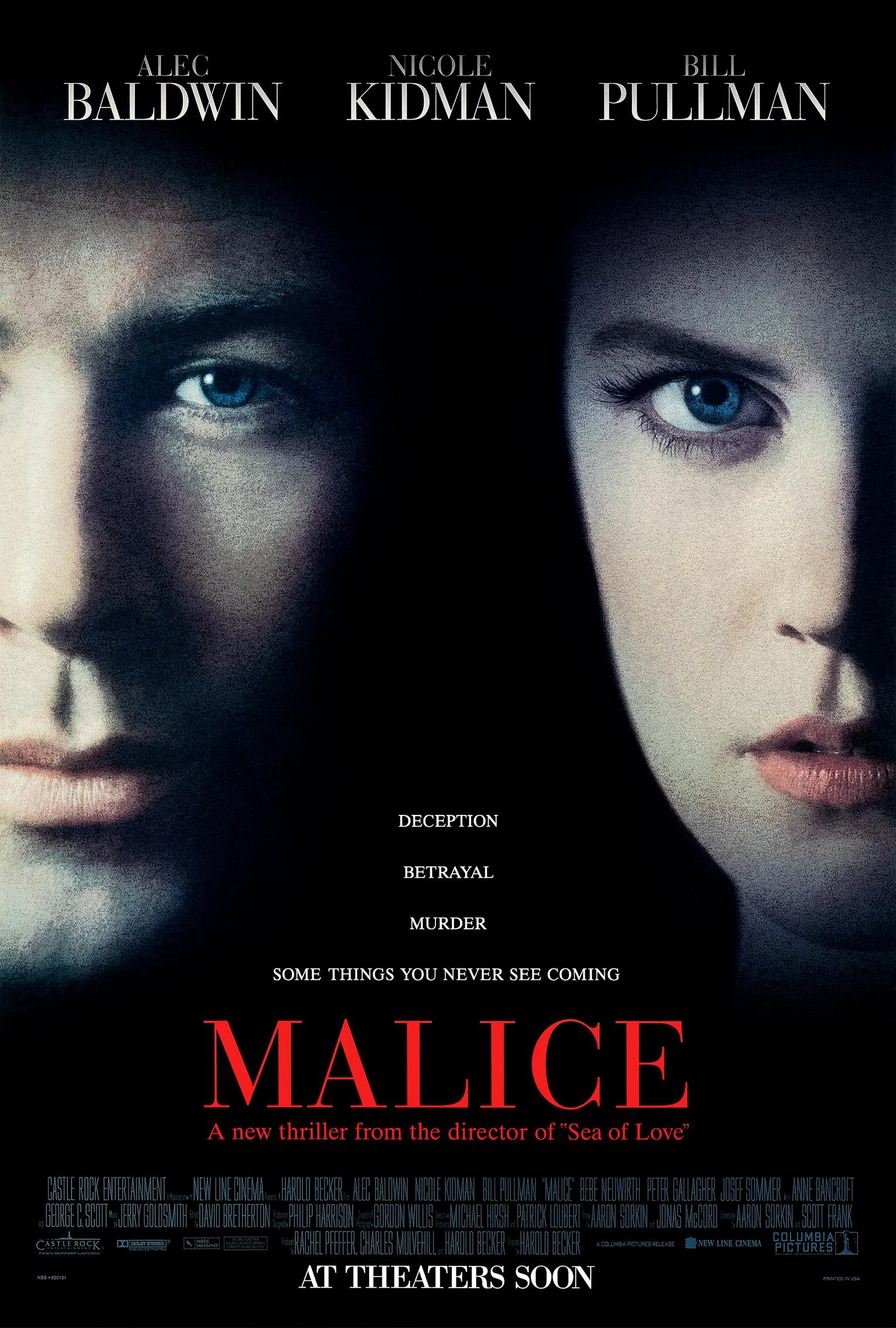
Columbia's one-sheet sold exactly this. Two half-faces in Gordon Willis shadow, a list reading deception, betrayal, murder, and beneath it the flat promise that some things you never see coming. Where Harold Becker's name should be is the line "from the director of Sea of Love", which tells you the studio knew what it was selling and it wasn't a director.
Vincent Canby, in the New York Times, filed the minority report, enjoying the cheat, calling the film deviously entertaining and noting that "no matter how wild the plot reversals, there's always a slightly madder one to come". Everyone else described the same fault in different words. Ebert called it "one of the busiest movies I've ever seen", noted that an entire serial-killer subplot is "thrown in simply for atmosphere", and warned that reconstructing the twists afterwards leaves you in "really deep molasses". Peter Travers, in Rolling Stone, granted the suspense and withheld the rest: Sorkin "could run a red-herring factory", and the film has "suspense but no staying power". Variety's Tim Gray held both positions at once, calling it "immaculately crafted" and "a virtual scrapbook of elements borrowed from other suspense pix". It sits now at 54 percent on Rotten Tomatoes and 52 on Metacritic.
None of which hurt it. Malice opened at number one on $9.2 million, finished at $61.6 million worldwide against a $20 million budget, took a B+ CinemaScore and became one of the twenty most-rented films in America in 1994. It was a hit twice, in cinemas and then on tape, and that is where the story of its popularity stops.
What actually survived is one scene, and it isn't a twist. Baldwin, in a deposition, asked whether he has a God complex: "I have an M.D. from Harvard. I am board certified in cardiothoracic medicine and trauma surgery... and I am never, ever sick at sea." Then the landing: if you want God, he was in operating room number two on November 17th, and he doesn't like to be second-guessed. The rest is trivia. Gwyneth Paltrow is in the abandoned subplot, pre-fame and barely there. Willis's photography went unremarked until a Kino Lorber Blu-ray decades later gave people a reason to look. Gray reached for Dead Calm to explain what Kidman was doing here, a comparison his review doesn't seem to notice is unkind.
The machinery rotted and the digression lasted, which I think settles the authorship question the credits leave open. The trapdoors every reviewer hung on Sorkin were substantially Frank's. The speech nobody can stop quoting is a man stating precisely what he is, out loud, on the record, with nothing in his back pocket at all. Sorkin left this film to adapt A Few Good Men, which ends with a confession argued out of a witness in open court rather than sprung on the audience. He has since explained his fondness for courtrooms by pointing out that a jury is a stand-in for the audience, twelve people who know as little as they do. That is the exact opposite instinct to a secret in a back pocket, and it is the one he kept.
Sources:
-
Malice (1993 film) — Wikipedia
-
Malice movie review & film summary — Roger Ebert
-
Malice — Peter Travers, Rolling Stone
-
Malice — Tim Gray, Variety
-
Reviews/ Film; An Idyll Shattered By Rape and Murder — Vincent Canby, The New York Times
-
Dr. Jed Hill on the question of a 'God Complex' — American Rhetoric
-
Nicole Kidman Tribute: Malice (1993) — The Film Experience
-
Malice — The Dissolve
-
Aaron Sorkin: Nine things we learned from his This Cultural Life interview — BBC Radio 4
Filed under Film & TV
This post is timestamped using Blockchain technology. Verify