Effortless Was the Luxury
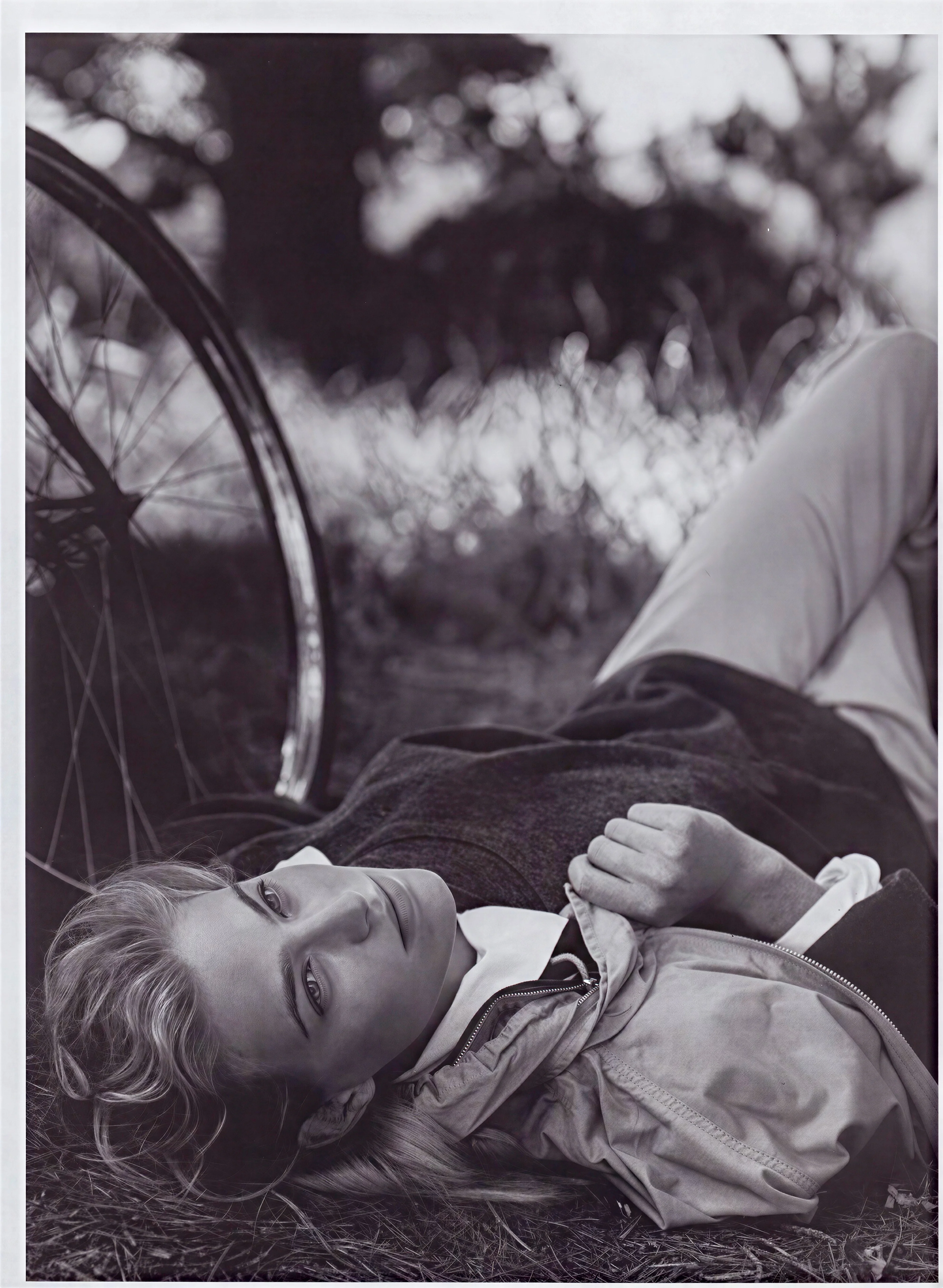
In this sun-flattened frame, Elaine Irwin lies back in long grass beside a bicycle wheel, jacket half-zipped, looking up at the lens as if it had wandered over on its own. It is Calvin Klein selling, in the autumn of 1989, by taking almost everything away. The loud decade was already deflating: the padded shoulders, the jewel tones, the Dynasty-grade excess that had dressed the money of the eighties suddenly looked overcooked, and a recession was on the way to make it look worse. Klein read that shift before most of the industry would admit it was happening, and the campaign he sent out that September answered the moment by subtraction: black-and-white film, an ordinary-seeming girl, and nothing you would call styling.
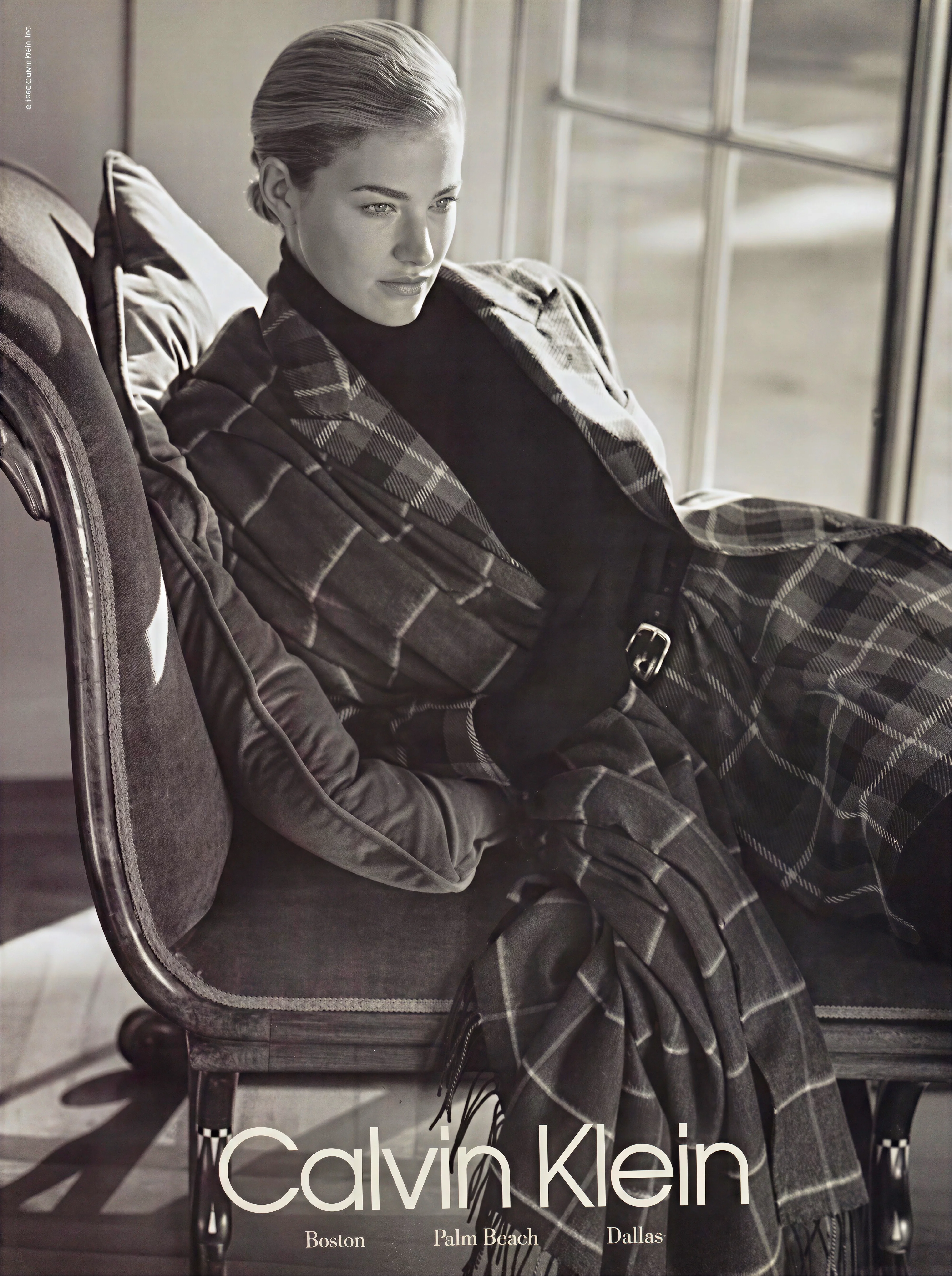
Calvin Klein in 1989 was two businesses wearing one name, and only one of them was really high fashion. At the top was the Collection, the runway line, expensive and severe, the clothes that got written up as American minimalism and shown on the season's most-wanted faces; I've looked before at the Fall 1989 Collection, restraint pared back to a bias cut and a bare shoulder, with Christy Turlington and Elaine Irwin both in it. Underneath sat the engine that actually paid for everything: the denim, the underwear, the fragrance. The jeans alone were running at something like a hundred and fifty million dollars a year by the late eighties. Obsession had already turned a scent into an empire, and a year before this campaign the same black-and-white register had sold Eternity as the wholesome opposite of Obsession's heat. He sold prestige at the top and sold the feeling of that prestige, cut with cotton and priced for everyone, at the bottom. The reach shows in one of the season's ads, Elaine wrapped in a plaid throw on a chaise with the wordmark set beneath her and three cities under that, Boston, Palm Beach, Dallas, the stores where the mood was actually for sale. The whole trick was making the cheap thing carry the expensive mood.
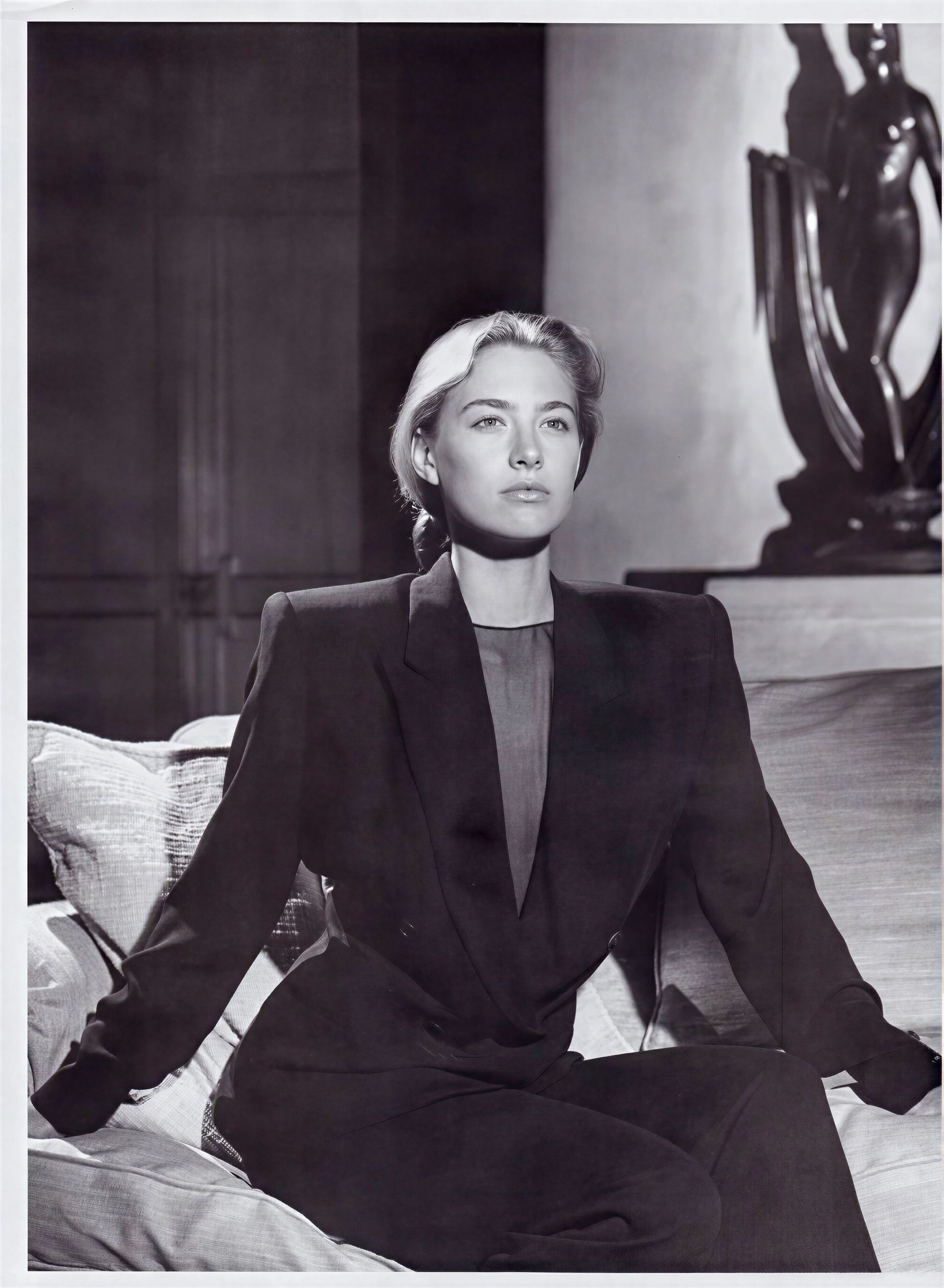
What was changing in women's clothes was really a change in what women were being asked to perform. Power dressing had told a woman to armor up, to prove she belonged in the room by matching its hardest edges. The new mood wanted the reverse: ease instead of armor, a body-skimming line instead of a built silhouette, grey and white and black instead of the full paintbox. You can see the shift even in the tailoring: a dark trouser suit worn open over a plain top, the shoulders gone soft, authority implied rather than announced. Armani had been quietly arguing for the same thing for years, and Donna Karan was building a whole business on jersey and drape. It looked like restraint, and restraint, done richly enough, signals money with nothing left to prove. Klein didn't invent the idea, but he sold it to America more fluently than anyone, and in doing so he set the thermostat for the entire next decade.
The timing sharpened it. A decade of dread around AIDS had quietly reweighted what a healthy, glowing body signalled on a magazine page, and the oncoming recession was making the wholesome look less like blandness and more like sense. A campaign built on ease and clean skin wasn't only a styling choice; it read the national mood back to the nation and called it taste.
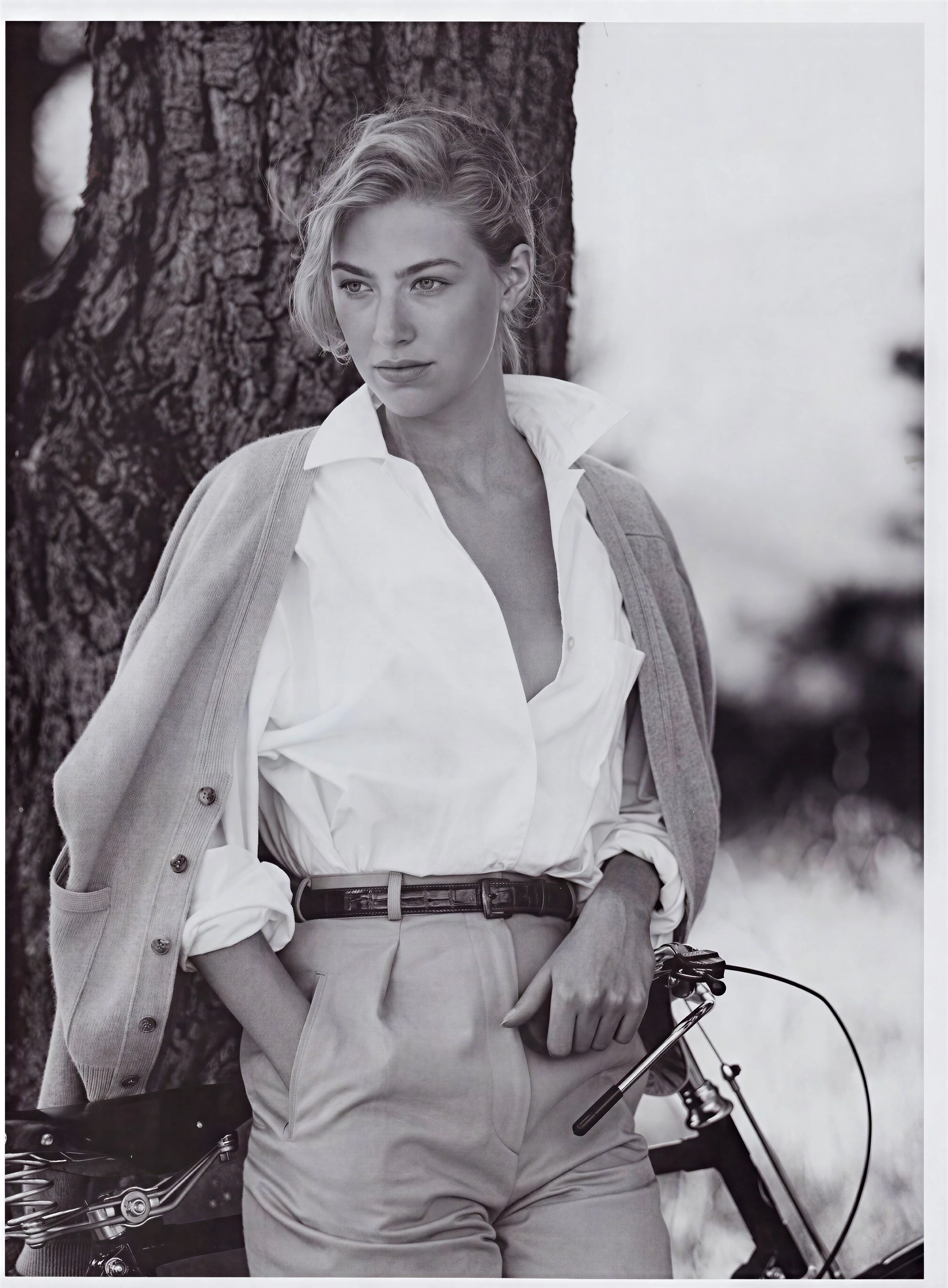
The look of the campaign came straight out of the house style Klein had built with Bruce Weber, whose black-and-white pictures had already been shaping the brand's advertising for years. Weber didn't photograph fashion as spectacle. He shot it as American weather, all sunlight and skin and unbothered physical health, closer to a family snapshot than an advertisement. The same weather runs through a pine-shadowed frame, the white shirt open, a cardigan slung over the shoulders, a bicycle at the edge of it, everything scrubbed of effort. There's no styling you'd stop on, no drama, nothing you could obviously point at and buy. That was the pitch. The clothes are almost incidental to the mood.
Which is why the choice of Elaine Irwin carries more weight than it first appears. Klein could have fronted the campaign with any of the era's monumental faces, and the Collection did exactly that. For the advertising he wanted something the supermodels had mostly trained out of themselves, a plainness that passes for honesty. The biggest names were hardening into logos of their own, monuments you booked at the price of everything else in the frame, and a face like that would have pulled focus onto itself and off the mood the campaign was selling. Irwin was known but not yet a monument, which is exactly what the job needed. She was born in 1969 in Gilbertsville, Pennsylvania, and she looked it: healthy, open, unmistakably homegrown, the kind of pretty that never announces itself as exotic or costly. The plainness had range. In a printed silk headscarf she reads patrician, closer to Grace Kelly than the girl next door, the same face doing old-money composure without shifting a muscle. By the end of the decade the all-American face would be its own booked-out category, and Klein was early to understand what it was worth.
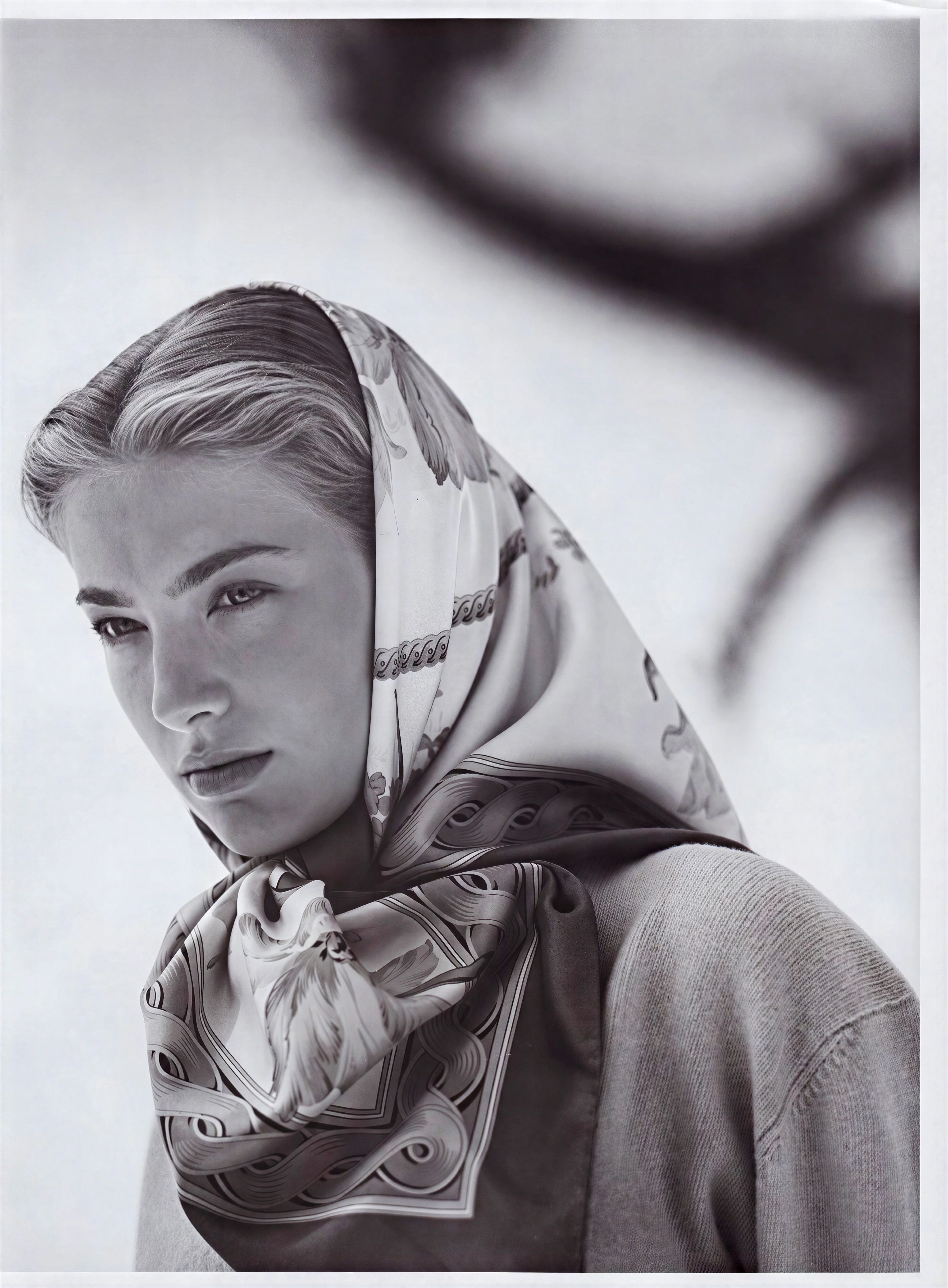
She wasn't the waif who would arrive with Kate Moss a few years later and knock the whole scale down. She still carried the glow and the robust health of the eighties model, but she carried it without the hauteur, and that made her a near-perfect hinge: familiar enough to trust, clean enough to point straight at the decade coming. There's a hard commercial logic underneath the sentiment, too. A face that looks like the customer sells to the customer. Fold her into an armchair in a cabled winter sweater and the picture barely registers as an advertisement so much as a person you might know. The glamazons sold aspiration, the fantasy of turning into someone unreachable; Irwin sold recognition, the quieter and more durable idea that the clothes were already yours, that you would look like this if you simply relaxed into them. For a house whose real volume moved in denim and cotton, recognition was worth more than fantasy.
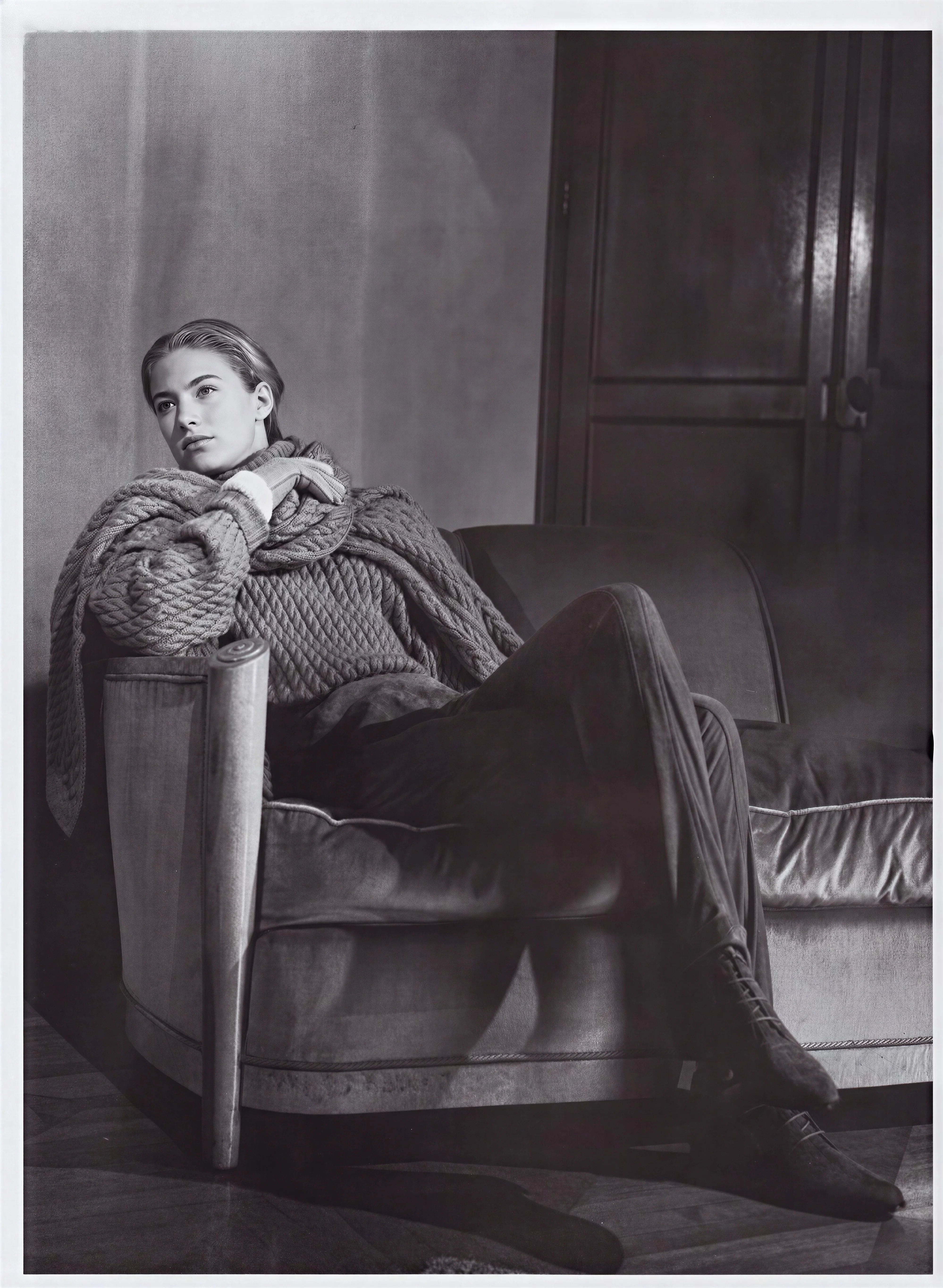
She would go on to the predictable places: Victoria's Secret, Ralph Lauren, the magazine covers, a 1992 marriage to John Mellencamp that briefly turned her into tabloid property. The 1989 pictures are the ones that fixed what she was for. They caught a very specific instant, the last of one decade's sunlit health handed straight into the cool restraint of the next, and they made the handoff look like nothing at all. If you were Calvin Klein in the autumn of 1989, nothing at all was the most expensive effect money could buy.
Sources:
-
Elaine Irwin — Wikipedia
-
Bruce Weber — Wikipedia
-
Calvin Klein: Minimalism, Branding, and Cultural Impact — Encyclopedia of Design
-
In Elaine's Lane — Santa Barbara Magazine
Filed under Calvin Klein · Elaine Irwin
This post is timestamped using Blockchain technology. Verify