The Restraint That Outlasted Everything
Cable knit, black and white, no jewellery, no set dressing — Christy Turlington and Elaine Irwin for the Fall 1989 Collection campaign, and a photographer who understood that nothing sells quiet confidence like actual quiet confidence.
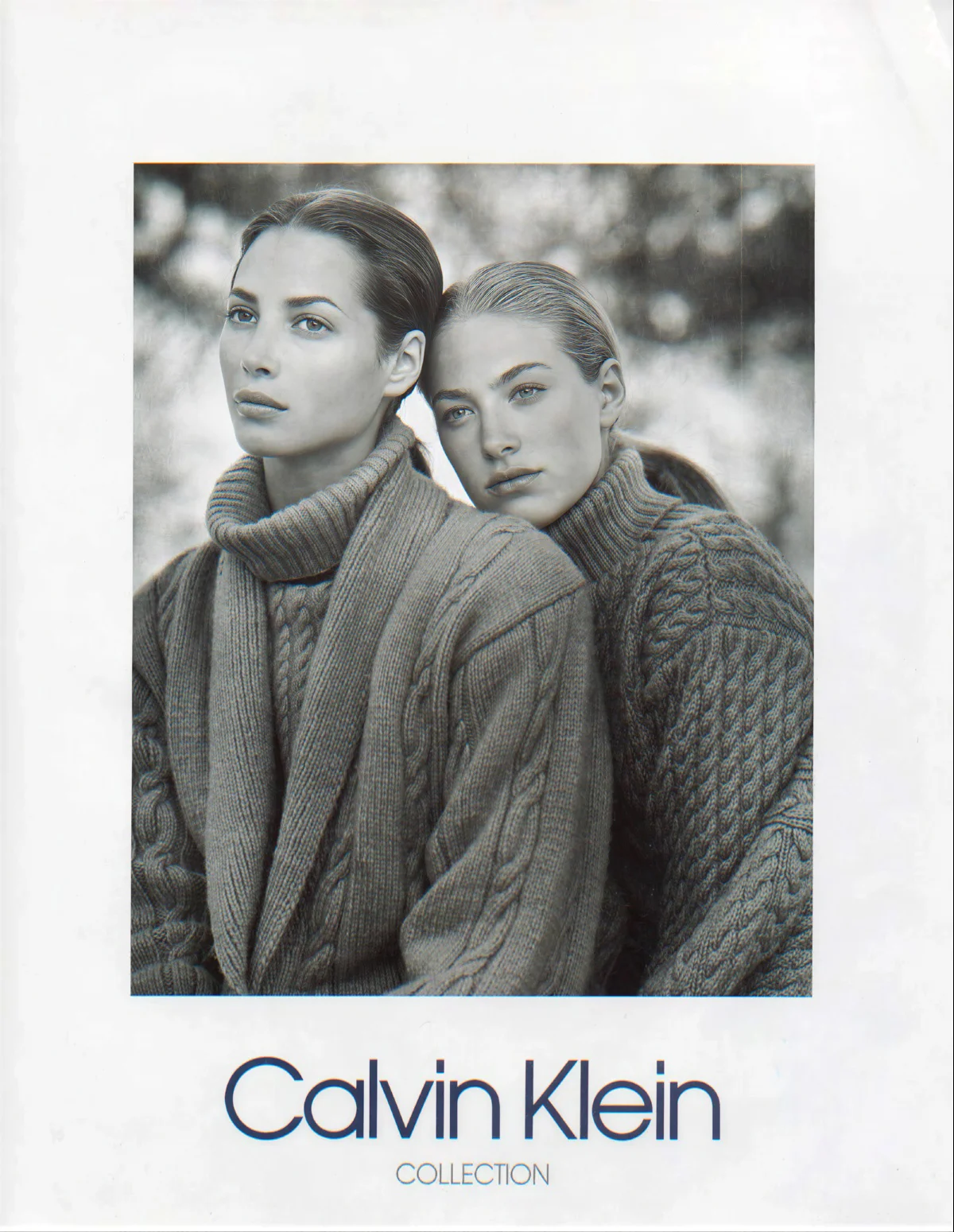
Calvin Klein’s 1980s print advertising shouldn’t have worked. The decade ran on excess — shoulder pads, neon, gold, volume. And here was a brand running black-and-white photography in a market saturated with colour, stripping fragrance campaigns down to bare skin and negative space while everyone else was layering on opulence. It was a bet against the visual language of the entire era. The era lost.
Richard Avedon set the template in 1980 with the Brooke Shields jeans campaign. A fifteen-year-old looking directly into the lens: “You want to know what comes between me and my Calvins? Nothing.” CBS and ABC pulled the spot within twenty-four hours. Four hundred thousand pairs of jeans were selling per week within a year. Klein learned something that would define every campaign that followed — the image that gets banned is the image that gets remembered.
Bruce Weber took it further. In 1982 he flew to Santorini and photographed Olympic pole vaulter Tom Hintnaus leaning against a whitewashed wall in white briefs. The image went up on a Times Square billboard and people were reportedly tearing posters out of bus shelters to keep them. American Photographer later named it one of the ten pictures that changed America. It was the first time mainstream advertising had sexualised the male body with the same directness routinely applied to women, and it turned men’s underwear from a commodity into a category that carried cultural weight.
Then Obsession in 1985. The tagline — “Between love and madness lies obsession” — could have anchored something overwrought. Instead, Avedon directed the television spots with Doon Arbus writing the copy, and Weber shot the print work in stark monochrome. Josie Borain stared out from magazine pages with an intensity that had nothing to do with selling perfume and everything to do with holding attention. The signature image from the later campaign — Weber’s 1989 photograph of a naked couple on a swing — is still arresting now. Not because of the nudity but because of the composition. It looks like it belongs in a gallery, and the fact that it was selling a $60 bottle of fragrance is almost beside the point.
What unified all of it was restraint. Clean backgrounds. Minimal props. Bodies and faces given room to breathe. In an era when fashion advertising meant cluttered sets and aspirational fantasy, Klein’s campaigns trusted the photograph itself. The product was almost incidental — a pair of jeans, a bottle, a waistband. What was being sold was a feeling: directness, confidence, a refusal to decorate.
Irving Penn photographed Christy Turlington for the Calvin Klein Collection campaign in 1988. Weber shot her again for the Eternity launch the same year, on Martha’s Vineyard with Lambert Wilson. Two campaigns, two photographers, two completely different moods — and both unmistakably Calvin Klein. That’s what a coherent visual identity actually looks like. Not a logo or a typeface but a consistent relationship with space and light.
The reason these images endure isn’t nostalgia. It’s that minimalism ages better than maximalism, and always has. The over-produced, hyper-saturated advertising of the same period looks exactly like what it is — a product of its moment, locked in time. Klein’s campaigns float free of their decade because they were already working against it. The restraint that looked provocative in 1985 just looks correct now.
Sources:
Filed under Calvin Klein · Elaine Irwin · Christy Turlington
This post is timestamped using Blockchain technology. Verify