Calvin Before Obsession
Calvin Klein launched a men’s fragrance in 1981 that most people have never heard of. Not Obsession. Not Eternity. Not even Escape. Just “Calvin” — lowercase on the bottle, uppercase nowhere else — marketed with four words that constituted the entire advertising proposition: “Fragrance for Men.” The Fragrance Foundation gave its packaging the 1982 Packaging of the Year award. Then the decade moved on, and Calvin Klein moved with it, and the scent that started everything quietly disappeared.
I spent a week researching this fragrance through primary sources — print ads, packaging photos, database reconstructions, corporate sale documents — and the thing that kept surprising me was how little survives. No press release from the 1981 launch. No named perfumer, just a house credit to IFF. No official note pyramid, just database approximations that disagree on whether the base includes oakmoss. For a brand that would soon become synonymous with cultural provocation, Calvin’s debut masculine was almost aggressively understated.
The bottle tells you everything about the original intent. Deep blue-black pack, silver typography, rectilinear glass designed jointly by Klein and Fabien Baron. This was modernist packaging in a decade that hadn’t yet decided whether it wanted modernism or maximalism, and Calvin bet on restraint. The industry noticed — that Fragrance Foundation award wasn’t for the juice, it was for the object. The design language predates Baron’s more famous work with Klein by nearly a decade, which means the aesthetic DNA of CK One and everything that followed was already present in 1981, just waiting.
The scent itself sits in the aromatic fougere space. Citrus-herbal opening — bergamot, neroli, chamomile, depending on which database you trust — into an aromatic floral heart of tarragon and orange blossom, settling on a woody-mossy base of patchouli, vetiver, musk, and possibly oakmoss. “Possibly” because no one has an official note list. Fragrantica includes mugwort in the top. Parfumo adds cinnamon leaf and vervain. The structure is consistent with what prestige men’s fragrance looked like in the early 1980s: clean enough for an office, complex enough to signal intent, nothing that would overwhelm a room. Perfume Intelligence classified it as an “aromatic masculine fougere edt” and moved on.
What makes Calvin interesting isn’t the composition — it’s the advertising strategy that would later become the brand’s entire identity. The 1981 print ad is product-led: bottle, carton, dark background, the “calvin” wordmark, and nothing else. No model, no lifestyle aspiration, no copy beyond the descriptor. By 1985, the execution had shifted entirely. An intimate couple-in-bed image with the same minimal overprint — “Calvin Klein” and “FRAGRANCE FOR MEN” — established the template that Obsession would detonate across every magazine in America the following year. The move from product shot to sensual lifestyle happened inside Calvin’s short advertising run, and almost nobody talks about it because Obsession eclipsed everything.
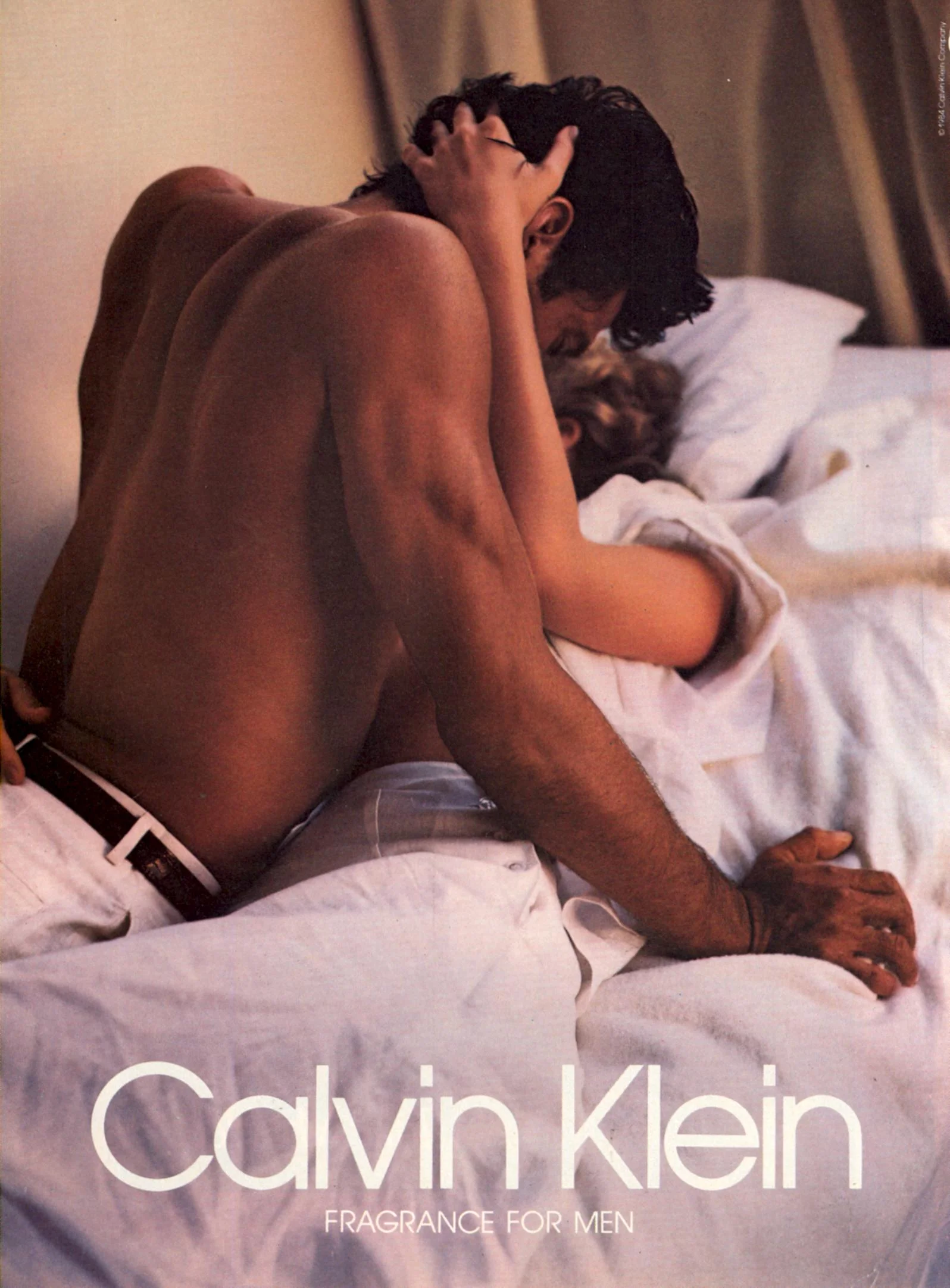
I keep thinking about the ingredient list on a boxed aftershave that surfaced in a collector listing. S.D. Alcohol 39-C, water, fragrance, P.P.G.-20, methyl glucose ether. “Calvin Klein Cosmetics Corp., Dist., New York” with a Vol. ‘85 marking. Five functional ingredients and a corporate address. The entire identity of a prestige men’s fragrance reduced to a label that could pass for industrial solvent. There’s something honest about that — the gap between the image and the chemical reality laid bare in a way that contemporary fragrance marketing would never permit.
Calvin was discontinued around 1990 and reportedly relaunched in limited form worldwide on 4 October 1999. I remember buying a bottle in the UK in September 1990 before heading off to drama college. The evidence for both events is thinner than you’d expect. Basenotes says discontinued. Parfumo says it “disappeared” in the early 1990s. A Fragrantica editorial notes the 1999 relaunch claim but adds that the brand never confirmed it. Some Basenotes reviewers say the 1999 bottles were “not quite the same.” Others say spot-on. Without analytical chemistry, the reformulation question stays unresolved, and the oakmoss issue — EU regulatory tightening around Evernia prunastri extracts — means any modern version would likely differ from the original regardless of corporate intent.
What happened around Calvin is more documented than Calvin itself. In 1989, Minnetonka’s deal transferred Calvin Klein Cosmetics to Chesebrough-Pond’s, a Unilever unit. The 1989 business reports note $158 million in sales, 82% domestic. Obsession, Eternity, and Calvin were listed as portfolio assets. By 2005, Unilever sold the entire Calvin Klein fragrance business to Coty for $800 million. Calvin the scent was long gone by then — a footnote in a deal worth nearly a billion, its name identical to the corporation that created it and therefore impossible to Google with any precision.
Vintage bottles surface on eBay occasionally. A boxed 50ml aftershave was listed recently at $185. Whether that reflects genuine market value or the optimism of a seller with a clean box and no comparable sales data is anyone’s guess. The collector market for pre-Obsession Calvin Klein is effectively nonexistent as a structured category. It’s just bottles that sometimes appear, priced by people who know they have something unusual but aren’t sure what it’s worth.
Nine years. That’s how long Calvin existed as a live product in its original run. Nine years of quiet authority before Obsession rewrote the rules about what a Calvin Klein fragrance could say, and how loudly it could say it.
Filed under Fragrance
This post is timestamped using Blockchain technology. Verify