Selling Forever in Black and White
I bought my first bottle of Eternity because of a magazine page.† The September 1988 issue of American Vogue carried the launch advertisement, and I went back to it more than once before I ever smelled the thing. That doesn’t usually happen with fragrance, where the bottle and the marketing tend to arrive together at the counter. This time the picture did the work first, and the scent had to live up to it.
What Calvin Klein understood, better than almost anyone selling perfume in the 1980s, was that the advertisement is the product. The liquid is real, but the fantasy is what crosses the register. Eternity launched on roughly an $18 million campaign and pulled in more than $35 million in its first year, numbers that only make sense if you accept that people were buying a feeling and the bottle came along as proof of purchase. The feeling, in this case, was permanence.
That word matters because of what came before it. In 1985 the same house had released Obsession, and the campaign for it was all heat and excess: tangled limbs, bodies stacked together, an atmosphere of appetite with no particular object. It sold beautifully and it suited the moment, the early-decade sense that desire was a thing you accumulated. I still have a soft spot for the original Obsession, and I’ve written before about hunting down a vintage bottle. But by 1988 the cultural weather had turned. The AIDS crisis had rewritten what sex meant in public, and the unbothered hedonism that made Obsession feel current suddenly looked reckless. Permanence, fidelity, one person you came home to: those were not just personal values anymore, they were the safe harbour the decade had started reaching for.
Eternity caught that turn exactly. Where Obsession was a crowd, Eternity was a couple. The launch image, shot by Bruce Weber on Martha’s Vineyard, gives you two people and nothing else. A man lying back with his eyes half closed, a woman folded over him, her hand pressed flat against his cheek, the whole thing in a grain of black and white that reads less like an advertisement than like a photograph someone kept. The woman is Christy Turlington, and the picture did as much for her as it did for the perfume. There’s a wedding band visible. Weber, who had shot Klein’s underwear work earlier in the decade, knew how to make wholesomeness look like charisma rather than restraint, and that’s the trick of the image: it’s chaste and it’s still charged.
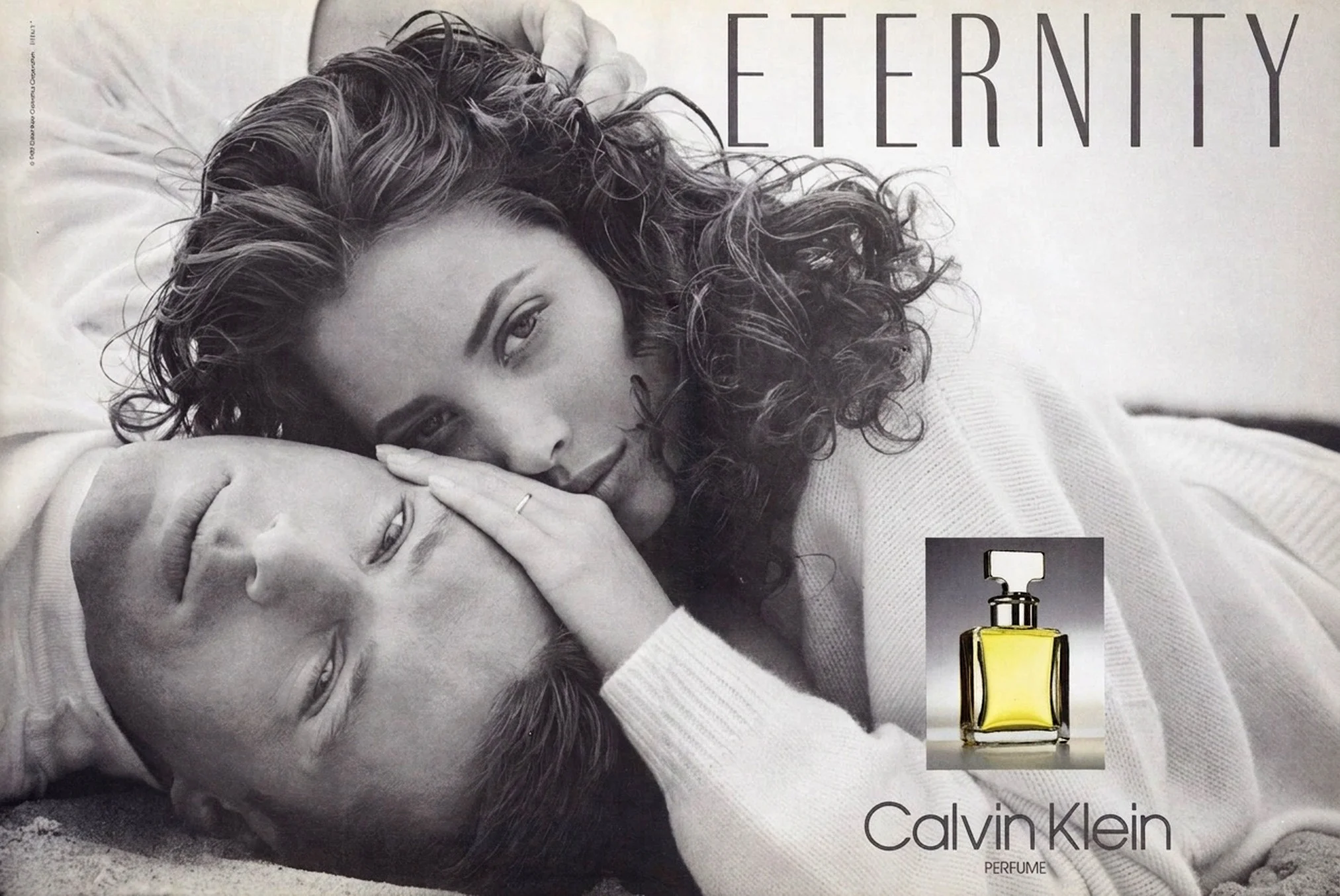
The casting tells you everything about the strategy. Obsession floated free of faces; you couldn’t have named the people in it if you tried. Eternity gave you one woman, returned to again and again, until Turlington and the fragrance were nearly the same idea. That is monogamy as a marketing structure.
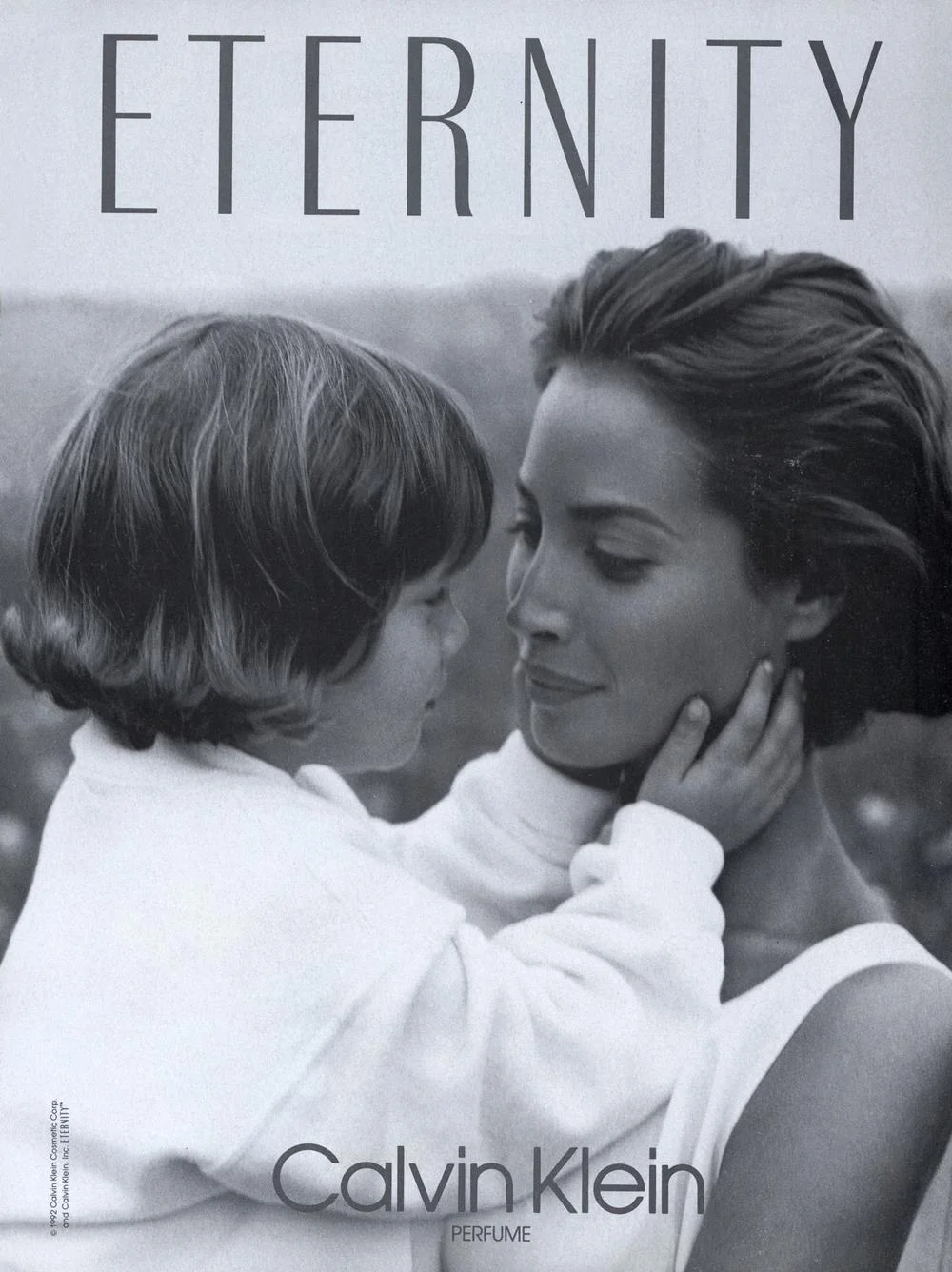
By 1992 the campaign had pushed that idea one generation on. Same grain of black and white, same Turlington, but the second figure is now a small child reaching up with his hand against her cheek, the exact gesture from the launch image turned around so the hand belongs to a son rather than a lover. The couple had become a family, and the permanence Eternity was selling widened quietly from fidelity into something closer to lineage.
Then there’s the smell, which I’d argue is the most underrated part of the whole project. Sophia Grojsman composed it, and she built something that behaves like the photograph: clean, green, lit from a cool angle. It opens crisp and floral and settles into something soft and slightly powdery, never loud, never the room-filling sillage that Obsession used like a weapon. People called it a green floral and credited it with launching a whole run of them through the early 1990s. What I remember is how legible it was. You could smell it on someone across a table and know exactly what it was, the way you can recognise a face, nothing about it reaching out to grab you first.
I think that legibility is why it has stayed with me. Obsession was a fragrance you wore to be a certain kind of person for an evening. Eternity was one you wore to be yourself, only slightly clearer. There’s a quietness to it that felt almost radical in 1988, when so much else in the culture was still turned up to maximum. Klein offered the opposite of the decade’s loud register, and it landed because plenty of people had quietly been ready for the change.
The brand has gone back to the well repeatedly since. Turlington herself returned for the campaign in 2020 and again a couple of years later, both times alongside her actual husband, which closes a strange little loop: the woman who once modelled the idea of a lasting marriage now modelling an actual one, decades on.
I don’t wear it now, and I’m not sure the current formulation is quite the one I remember; reformulations have a way of sanding the corners off. But the page from that September issue is still vivid to me in a way most advertising isn’t, and I’m fairly sure that’s because it asked for something closer to belief than attention.
Amendment, 27 June 2026. The page ran in September 1988, but I didn't buy a bottle then. Eternity only reached the UK in September 1990, and that's when I bought my first one. ↩
Sources:
-
Christy Turlington Burns Reflects on 34 Years as the Face of Calvin Klein Eternity — Harper’s Bazaar
-
The History of Calvin Klein — Perfume Direct
-
Bruce Weber, Christy Turlington for Calvin Klein Eternity, Martha’s Vineyard, 1988 — Galeria Alta
Filed under Fragrance
This post is timestamped using Blockchain technology. Verify