Armani Without the Armour
Peter Lindbergh photographed Laetitia Herrera on a stone ledge for Armani's autumn/winter 1994 campaign, and this page ran in American Vogue that September. She sits with her legs crossed and both hands resting on one knee, in a collarless jacket piped along its edges, a fine ribbed top and knitted trousers so soft and loose they could pass for something you'd sleep in. Her hair is scraped straight back, and the background has dissolved into a sepia haze that might be sea or might just be weather.
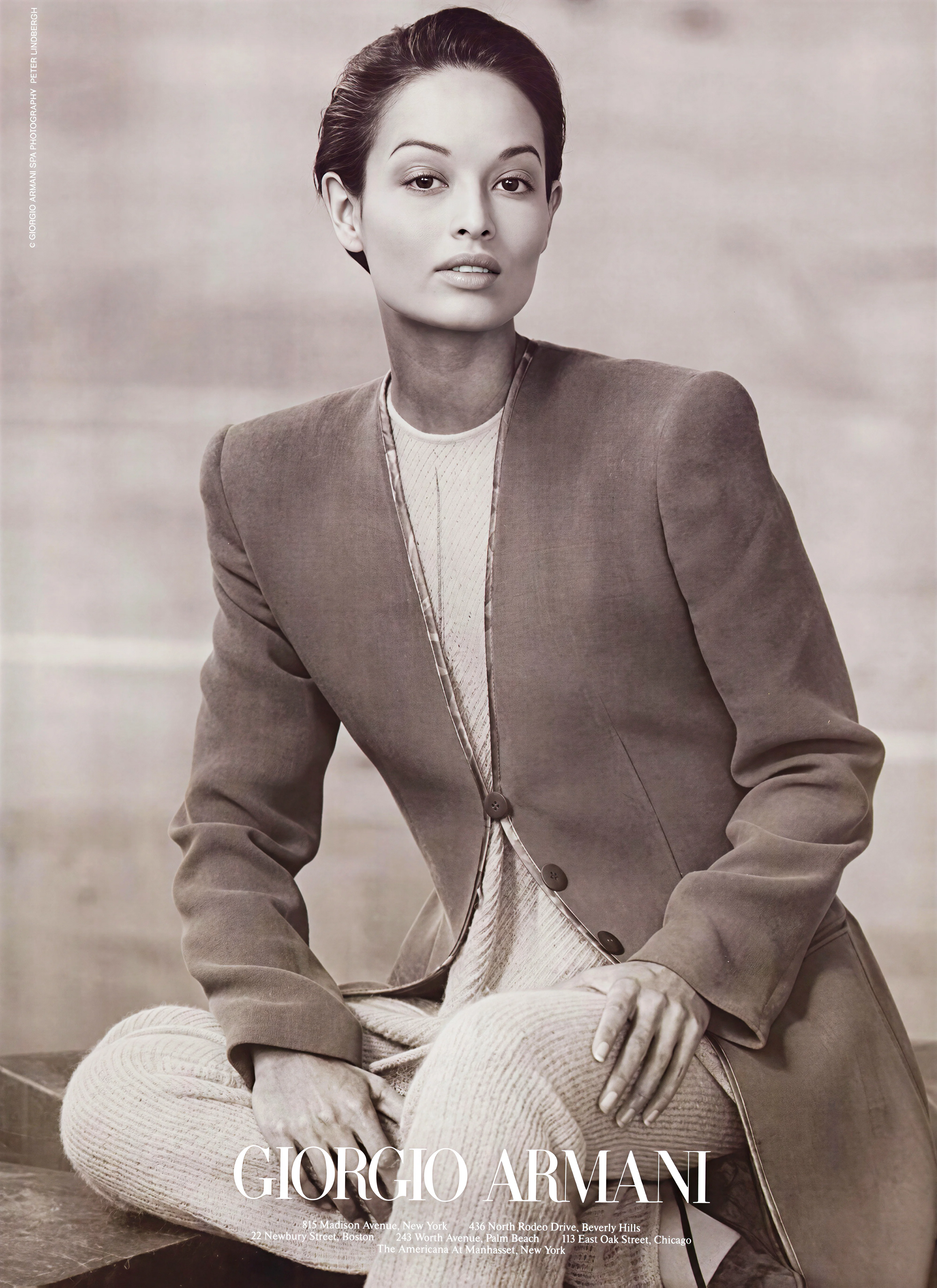
The early eighties asked the clothes to do far more shouting. Tad Friend, in Vogue's March 1992 issue, describes how at the end of the seventies Armani "extended and padded the shoulders to create the wedge-shaped power suit", the silhouette most people still picture when they hear his name. Aldo Fallai shot the 1981 campaigns, and that autumn's collection went further still, borrowing from ō-yoroi, the ceremonial armour of the samurai, according to Armani's own archive. By the middle of the decade he'd already dropped the power suit for what Friend calls "the looser, roomier sack suit", so the softer line was hardly new by 1994. The jacket on Herrera still has a shoulder, a padded one, but it's rounded off and slopes into the sleeve instead of squaring away from her neck. Armani's own line on it: "The eighties shoulder was a woman's manager. Now she doesn't need to tell anybody what she is. She is."
The bigger change is in how a look got dressed for the camera, and Armani told Friend this too. Ten years earlier, he said, a kimono cardigan would have come with "a geometric hat, a geometric piece of jewelry, to bring it overboard so people would pay attention. Now I almost want to go unnoticed." Herrera's page is that sentence turned into a photograph. No hat, no earrings, no necklace, nothing on her wrists. The knitwear on her legs pulls the tailoring down towards something like lounging, and the haze behind her refuses to tell you where she is.
The same interview has Armani saying that "with the Berlin Wall down, it would be offensive to make clothes that are screaming with luxury". Along the bottom of this page runs Madison Avenue, Rodeo Drive, Newbury Street in Boston, Worth Avenue in Palm Beach, East Oak Street in Chicago, and The Americana at Manhasset out on Long Island. Aldo Fallai's spring 1989 page for the house had listed two shops. I don't read that as hypocrisy. A look that refuses to shout is easier to sell in six places than one that only makes sense on Madison Avenue, and the restraint may well have been part of how the list grew.
Sources:
-
GA_W_FW_1994_26 — Archivio Armani
-
Giorgio Armani Archivio — Giorgio Armani
-
The Armani Edge — Vogue
Filed under Giorgio Armani · Laetitia Herrera
This post is timestamped using Blockchain technology. Verify