Not in the Archive
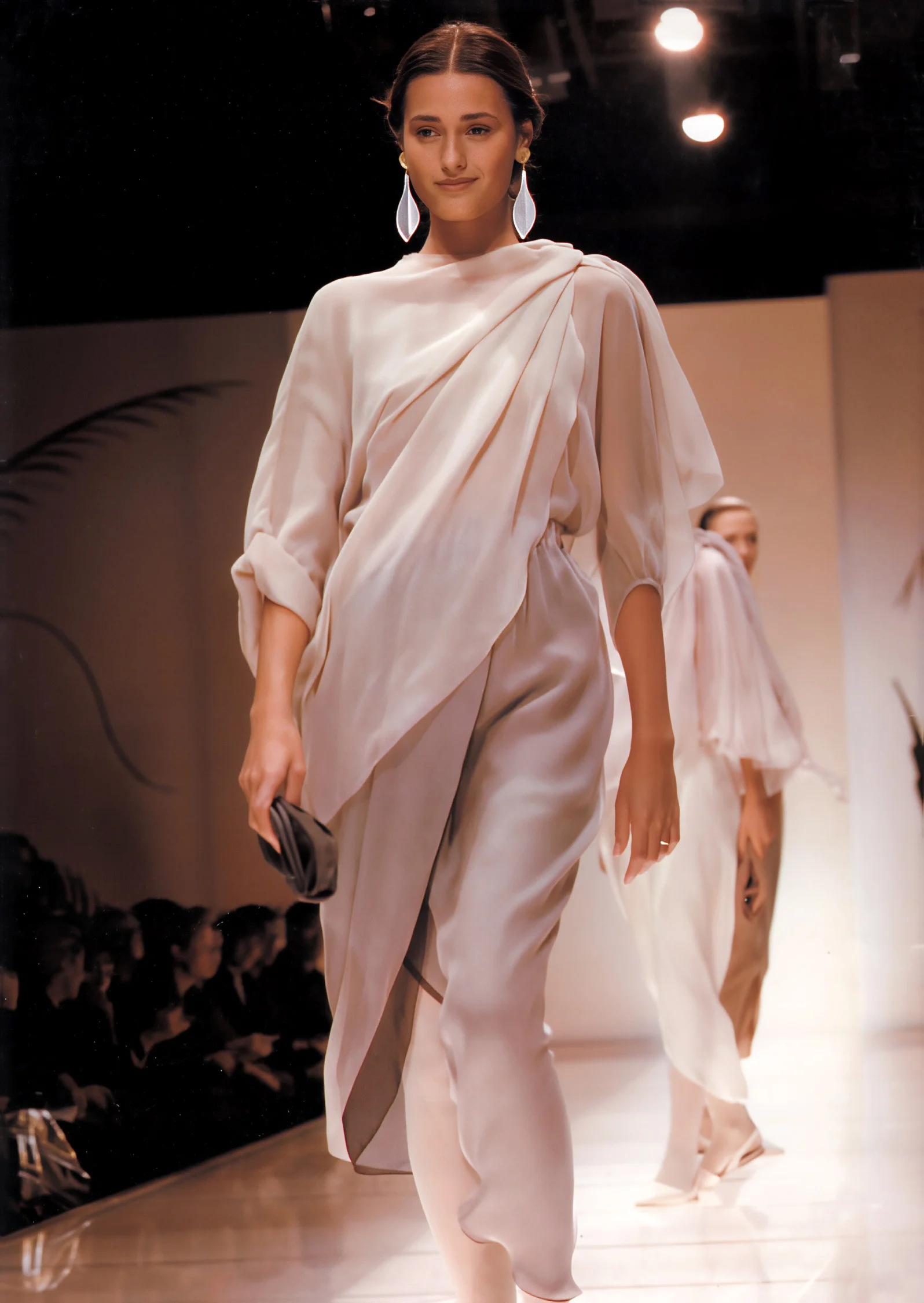
There's an Armani everyone remembers, and it isn't this one. The Armani everyone remembers is cut from charcoal wool, has a pinstripe somewhere on it, and lets the jacket's shoulder do most of the talking. The one walking the Milan runway in October 1987, for the Spring/Summer 1988 collection, is a different animal. Cream silk. Draped across the body like something half-borrowed from antiquity. No shoulder to speak of. The jacket-as-engine idea from American Gigolo isn't what this is doing.
The house's own memory agrees. Armani's official Archivio holds the Fall/Winter 1988 womenswear collection in full, look by look, with fabric notes and source references attached. The Spring/Summer season that came six months earlier isn't there. I don't mean the entries are thin. I mean there's no entry.
The photographic record exists. Getty holds a Donato Sardella runway photo from that exact show, credited to WWD. Aldo Fallai shot Burke Hudson in the season's menswear and the prints surface on fashion blogs and dealer archives. So the collection happened, it was documented by the people whose job was to document it, and then the house itself chose to leave it out of its own memory.
That's the kind of gap I find interesting. Not a conspiracy, just a quiet self-edit. Designers edit their own legacy all the time, usually toward whichever work the house wants people to think about now.
Which is odd here, because the power suit is really a cultural projection. Mostly American, mostly Richard Gere's fault. Armani was planted firmly on the restraint side of the Italian ready-to-wear split, against everything Versace was doing across town, but the restraint wasn't ever really in the shoulder. It was in the fabric, the palette, the refusal to decorate. Which is another way of saying the silk in this photograph is closer to the centre of the Armani register than the pinstripe is.
The fabric falls across one shoulder and pools at the hip, draped like a chiton, pale like sun-bleached stone. It's borrowed light. A designer whose actual signature is soft drape shouldn't need to hide a season that makes the case so clearly. Unless the case makes another problem more visible.
I've been turning over why the house skipped this season. The simplest answer is that Fall/Winter is easier to museum. Wool, structured at the shoulder, architecturally clean. The kind of collection you can hang on a mannequin and photograph under gallery light. Spring/Summer is lighter, harder to display. Silk instead of wool. Photographs well in motion and badly in a case.
And the silhouette here is close to what Azzedine Alaïa was doing a couple of years later, the same body-conscious fluidity, the same refusal to treat the shoulder as a load-bearing piece. Armani and Alaïa are usually filed into different boxes, suits versus bodies, Milan versus Paris, restraint at war with sensuality, and I'm not sure either box holds up once you put these two seasons next to each other. The Armani in this photograph would slot into an Alaïa retrospective and nobody would flinch.
Maybe that's why the house left it out. Too close to someone else's territory.
Sources:
-
Giorgio Armani Womenswear Fall-Winter 1988 — Archivio Armani
-
Giorgio Armani Spring 1988 Ready to Wear Runway Show — Getty Images
Filed under Giorgio Armani
This post is timestamped using Blockchain technology. Verify