Pearls Sewn to a Hem
A short cream panel falls across the bust and stops, unattached, and from its loose hem hangs a row of long baroque pearls, each one drilled and caught at the top so it points down and swings. Two more hang from the collar points, like the ends of a tie nobody bothered to knot. The shirt they are fixed to gives them nothing to compete with: sleeveless, plain, an oversized pointed collar, no shoulder pad, no structure asking to be admired.
Ornament living on a construction line is not new. Buttons, frogging and passementerie all sit on the working parts of a garment. What is different here is that none of this is fixed flat to anything. The pearls hang off a free edge, at the size you would otherwise expect around a throat, doing the job of beaded fringe.
Yasmeen Ghauri does the sensible thing and holds still, hand in the pocket, chin level, face at neutral, so that that fringe of pearls is the only part of the look with any movement in it. She does the same withholding under a Valentino hat two years later, and it works for the same reason: the clothes are already performing.
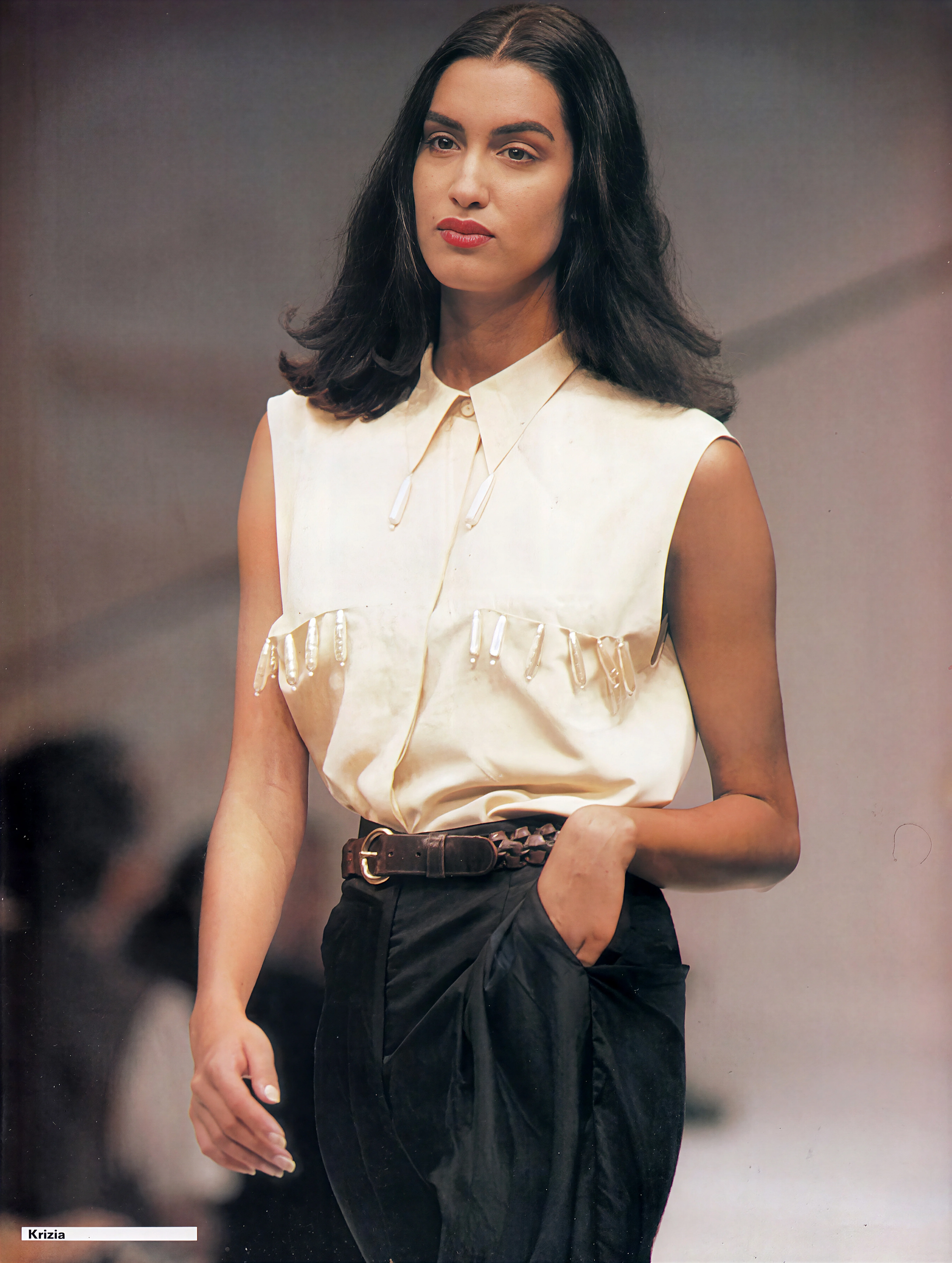
Bernadine Morris’s review of the Milan spring shows ran in the New York Times the next morning, and found that at Krizia “the pendulum has swung here from precision tailoring to insouciant soft dressing.” She was writing mostly about dresses rather than anything like this, but the diagnosis holds for a shirt with no internal structure left in it. Once the tailoring goes, something has to supply the interest, and Krizia’s Mariuccia Mandelli hung it off the hem. The belt is doing its bit too, plain braided leather on a plain gold buckle, ordinary enough to keep the eye up at chest height.
Five months later Mandelli was running narrow cords across a violet jacket, ornament pressed flat into the surface and holding still. The pearls are the same instinct with the fixings left loose.
Sources:
-
Review/Fashion; Milan Shows: Lots of Color and Skin — The New York Times, 9 October 1990
-
Krizia Spring 1991 Ready to Wear Runway Show — Getty Images
Filed under Krizia · Yasmeen Ghauri
This post is timestamped using Blockchain technology. Verify