Twelve Hundred Guests and a Bad Headline
On 23 February 1981, Yves Saint Laurent launched a men’s fragrance at the Opéra-Comique in Paris and had Rudolf Nureyev dance for twelve hundred guests. The tagline was un parfum pour dieux vivants, a perfume for living gods. A spokesman at the press conference called it the most expensive male perfume on the market. Ten days after that party, the Palm Beach Daily News ran a piece under the headline “Kouros Debut Lacked Sweet Smell of Success.” I can’t get past that headline, all that survives in the citation trail, sitting oddly against a scent that then ran forty-five years without a break.
The name came out of a holiday. Saint Laurent had been to Greece and came back fixed on the archaic statues of young men, the kouroi. He described the blue of the sea and sky, the intense freshness of a world given over to beauty, and then seeing those figures again, and said he had his perfume and its name in one go. Nothing about that account predicts what turned up in the bottle.
Pierre Bourdon composed it. He had joined Roure Bertrand in 1971 to study under Jean Carles, and spent his apprenticeship being corrected by Edmond Roudnitska on bicycle rides. What he delivered was not freshness and marble. Under a bright opening of bergamot and bitter artemisia sits civet and oakmoss, held so that soap and animal never quite resolve into one or the other. Which of the two you notice has been a matter of temperament ever since: when Chandler Burr covered it for the New York Times in 2007, he ran the piece under the title “What the Cat Dragged In.”
The advertising made no attempt to soften that. The bottle, a white flask with a chrome collar built to read as a Greek column, appears in the campaign held against a sunburnt shoulder, against a blue lifted straight out of Saint Laurent’s account of the Aegean. The face is turned away and cropped at the jaw, there is no setting, and no line of selling copy anywhere beyond the logotype across the foot.
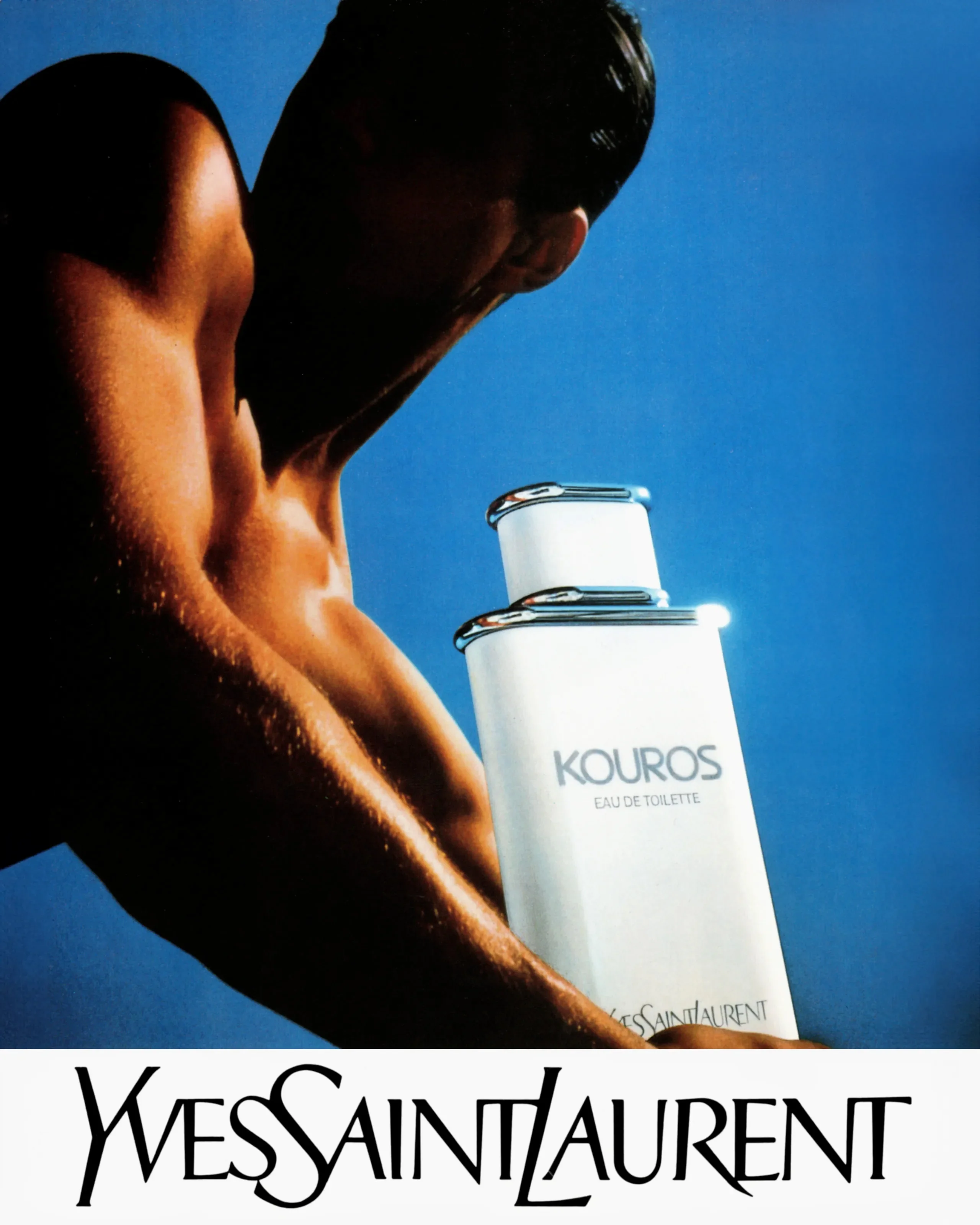
Nineteen eighty-one was a crowded year for masculine scent. Calvin Klein put out a men’s fragrance in the same twelve months that almost nobody remembers. Kouros proved that a men’s fragrance could be enormous, strange and openly carnal and still sell at scale for decades, and a proof like that changes what a marketing department will sign off. Dior’s Fahrenheit arrived in 1988 smelling of petrol, by which point a difficult masculine was a known quantity rather than a gamble.
The vintage bottle question follows directly from that longevity. Kouros has run continuously since 1981 under five owners, and collectors date bottles by that chain: Charles of the Ritz to 1986, the American Parfums Corp. period from late 1986, Sanofi from 1993, PPR and Gucci from 1999, L’Oréal from 2008. Boxes and bases moved with each handover. The useful tell for the earliest stock is the silver metal base, where between 1981 and 1985 the batch code could be painted on rather than stamped, and some bases from the first year carry no inscription at all. Collectors rate that opening period the highest of the five.
Whether the juice changed as often as the packaging is less settled. A first reformulation in 1986, softening the animalic notes for a wider international audience, is disputed to the point that specialists call it the ghost reformulation, with some tasters finding no difference at all. The later changes are not disputed. Oakmoss came under tightening restriction and civet went the way of most animal materials, and by the 2000s people who had worn it since the eighties were reporting that the floor had dropped out. Build a scent on materials the industry later withdraws and this is what you get, which is why old bottles carry the weight they do.
Kouros is still on the shelf, which is the odd part. The flankers came and mostly went, Kouros Fraîcheur in 1993 and Body Kouros in 2000 among them, while the original survives as a quieter, drier version of itself at ordinary designer prices. So there are two objects now wearing the same name. One turns up on the discount shelf, and the other is a sealed box with a painted code on the base, and only the second one is what Bourdon actually signed off in 1981.
Sources:
-
1981 - 1982 Kouros Fragrance — Musée Yves Saint Laurent Paris
-
Kouros (perfume) — Wikipedia
-
KOUROS: The Scent of Gods (1/2) — Raiders of the Lost Scent
-
Pierre Bourdon — Now Smell This
Filed under Fragrance · Yves Saint Laurent
This post is timestamped using Blockchain technology. Verify