179 Francs and a First Name
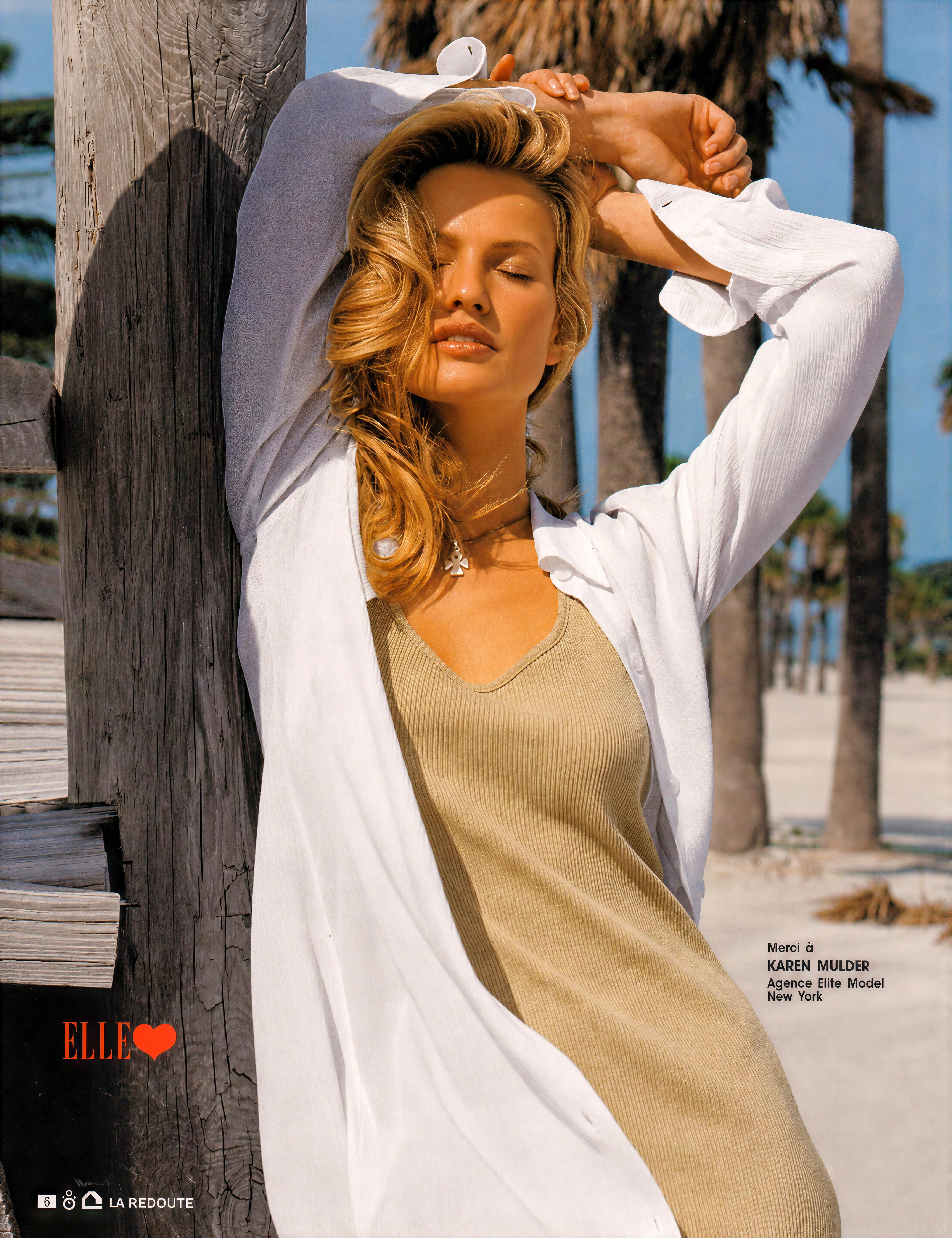
Bottom right of page six, set smaller than the product codes: “Merci à KAREN MULDER, Agence Elite Model New York.” A mail-order house in Roubaix, thanking a Dutch model through her New York agency, in a book that sells ribbed cotton vests by reference number. The whole 1994 strategy sits in that one line of eight-point type.
Mulder was near her peak. Elite had signed her at fifteen, after a contest she’d seen advertised in a newspaper, and by 1994 she’d walked Chanel couture and was two years into Victoria’s Secret. She wasn’t one of the five women on the January 1990 British Vogue cover, though, and I think that’s exactly why she’s here rather than in the advertising. La Redoute had put Linda Evangelista in its television spot the year before, and a spot is a thirty-second prestige purchase. A catalogue is eight million copies of working sales material, and it needs someone who can stand next to a 179-franc shirt without making the shirt look like a joke, which is a narrower and far more useful skill than fame. She did the same thing on a Ralph Lauren runway, where the plainest look in the show turned out to be the one that sold.
By then the company had stopped pretending its customer lived in a village. L’Express reported in 1993 that the days when only “la mémé de la Creuse” ordered her blouses by post were finished, and that the target had become working women with money and no time. Guy Latourrette, who ran the catalogue, explained it through the recession: in a downturn people stay at home, so the catalogue goes to them and moves at their pace. Which is how a Roubaix knitwear range ends up shot on a Californian beach, with Mulder eyes shut against the pilings as though nobody in the frame were selling anything.
Borrowing prestige wasn’t new there. The house had been inviting guest designers since 1969 and would later run Azzedine Alaïa in its pages, and the logic never really changed: the clothes are cheap, so the names standing beside them have to be expensive.
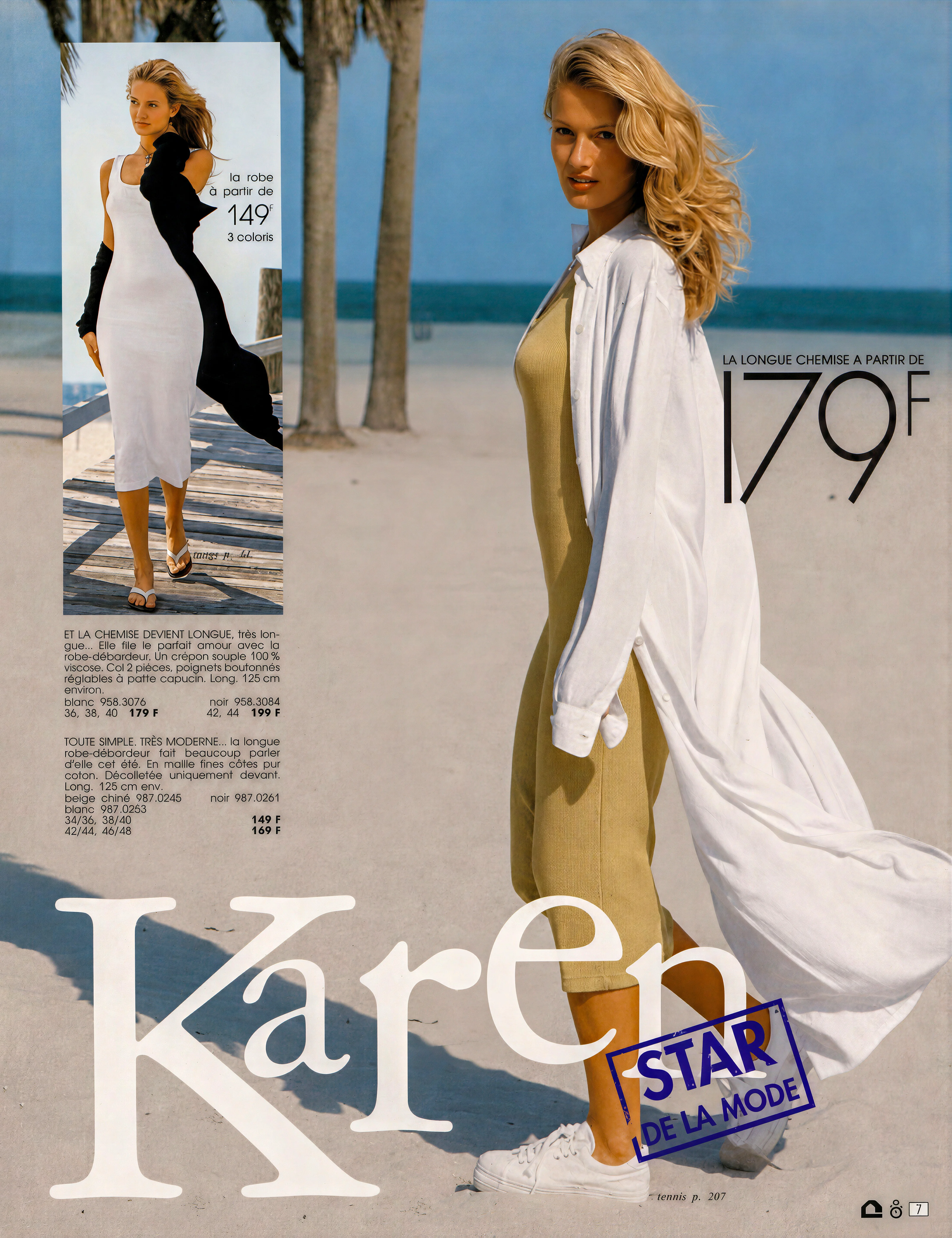
Turn over and the machinery is right on the surface. Page seven sets her first name in white display type running a third of the sheet, stamps STAR DE LA MODE across her shin in blue, then hands you crépon souple, 100% viscose, 125 cm, blanc 958.3076 and noir 958.3084, sizes 36 to 40 at 179F and 42 to 44 at 199F. The single first name was the supermodels’ own convention, and here a mail-order house in the Nord just takes it.
The takeover came the same year. Pinault-Printemps already held control and moved to absorb the company outright, which is where the group got the name Pinault-Printemps-Redoute. Jean-Claude Sarrazin, who ran the business for years, put the cost of that plainly: afterwards La Redoute no longer had the means to try things. That matters more than the ownership relay that followed, because trying things had been the entire method, from the first distance-selling catalogue in 1928 to the Minitel service in 1982. Kiabi, Zara, Camaïeu and Promod were soon changing collections faster than eight million copies could be printed and posted, the website didn’t arrive until 1996, by which point a URL in a fashion advert still had to be spelled out in full, and La Redoute shed two thousand posts in under five years.
Kering sold it for a symbolic euro in 2014. This spring the catalogue itself went into a vitrine at La Piscine, the museum built into a converted swimming baths a few streets from where Joseph Pollet started spinning wool in 1837, where the exhibition ran until the fifth of July. The 179-franc shirt is an exhibit now, and so, in a smaller way, is Karen.
Sources:
-
Tous catalogués — L’Express
-
Les pionniers de la VPC peinent à changer d’ère — Les Echos
-
La Redoute, un temps d’avance. Mode, design, publicité — Musée La Piscine, Roubaix
Filed under Karen Mulder
This post is timestamped using Blockchain technology. Verify