Gucci Before the Red Velvet
Heather Stewart-Whyte meets the camera in close-up, wrapped in olive silk printed with grapes, crests and small geometric panels. The scarf is less an accessory than the whole environment. Only a white sleeve and square gold earring interrupt it. The November 1991 issue of American Vogue carried Gucci advertising from this campaign. I like that the image doesn't pretend to announce a revolution.
Gucci hadn't yet become the shorthand for sex and hard glamour that would define it four years later. The house was trying to recover its authority after family disputes, careless licensing and too many products had weakened the name. Dawn Mello had arrived from Bergdorf Goodman in 1989 to impose discipline. Tom Ford joined in 1990, initially working on women's ready-to-wear. The famous red velvet trousers, satin shirts and Halston-lit confidence still lay ahead.
The picture's richest decision is restraint. A print this busy could easily have become an exercise in conspicuous luxury, but the framing denies it room to spread. Instead, Stewart-Whyte's direct gaze fixes the page. Her hair moves in large, deliberate curls; her expression doesn't. Gucci's name sits at the bottom in white, almost detached from the garment it is meant to identify.
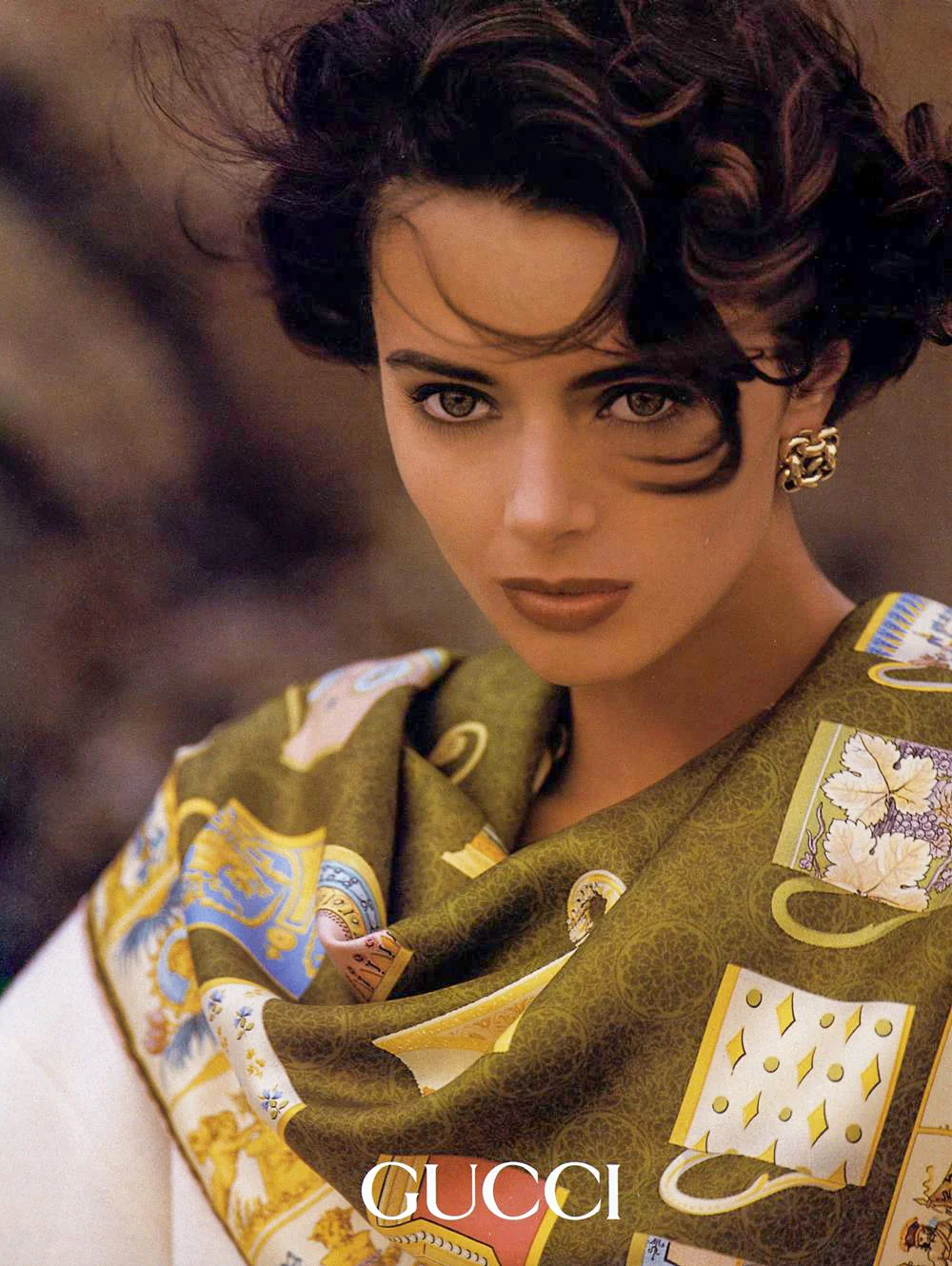
Stewart-Whyte was well suited to this version of the house. She had the strong, clean features of the early 1990s model generation, but she could make polish look severe rather than sweet. The advertisement asks her face to control the ornament. That tension gives the image its charge: old-world motifs gathered around a woman who looks entirely contemporary.
I find it difficult now to see any early-1990s Gucci image without reading Ford's later success backwards into it. Yet this isn't the Gucci of the unbuttoned shirt and velvet trousers. WWD's archive places Ford's official debut as head designer in 1991, while Mello was still directing the broader recovery. Their task was not simply to make a good collection. They had to persuade people that Gucci could produce fashion, not merely trade on loafers, handbags and a famous double G.
The advert feels transitional in a precise way. Its silk print and gold hardware speak the established language of an Italian luxury house, while the crop, the hair and Stewart-Whyte's composure pull it towards the decade forming around it. Nothing here predicts the fever of 1995: no nightclub fantasy, no exposed skin, no calculated provocation. Gucci is still deciding how much of its past to wear, and Stewart-Whyte holds all that ornament steady with one unblinking look.
Sources:
-
American Vogue, November 1991 — Vogue Archive
-
Heather Stewart-Whyte — Wikipedia
Filed under Gucci · Heather Stewart-Whyte
This post is timestamped using Blockchain technology. Verify