Kenar Spent Itself Famous
The woman crossing a sunlit New York street in this grey houndstooth suit is Monica Bellucci, a few years before most people would learn her name from a film. She's dressed for a city morning, black gloves, a small dark handbag, parked cars stacked behind her on a bright avenue. The page ran in American Vogue in September 1990, the wordmark set in wide capitals at the bottom, KENAR 2, and under it the short list of stores that carried the label: Dayton-Hudson, Marshall Field's, I. Magnin, Bloomingdale's. That list is the whole business plan. Kenar didn't sell under its own roof yet. It sold through the good department stores, and spent to make sure you knew the name before you got there.
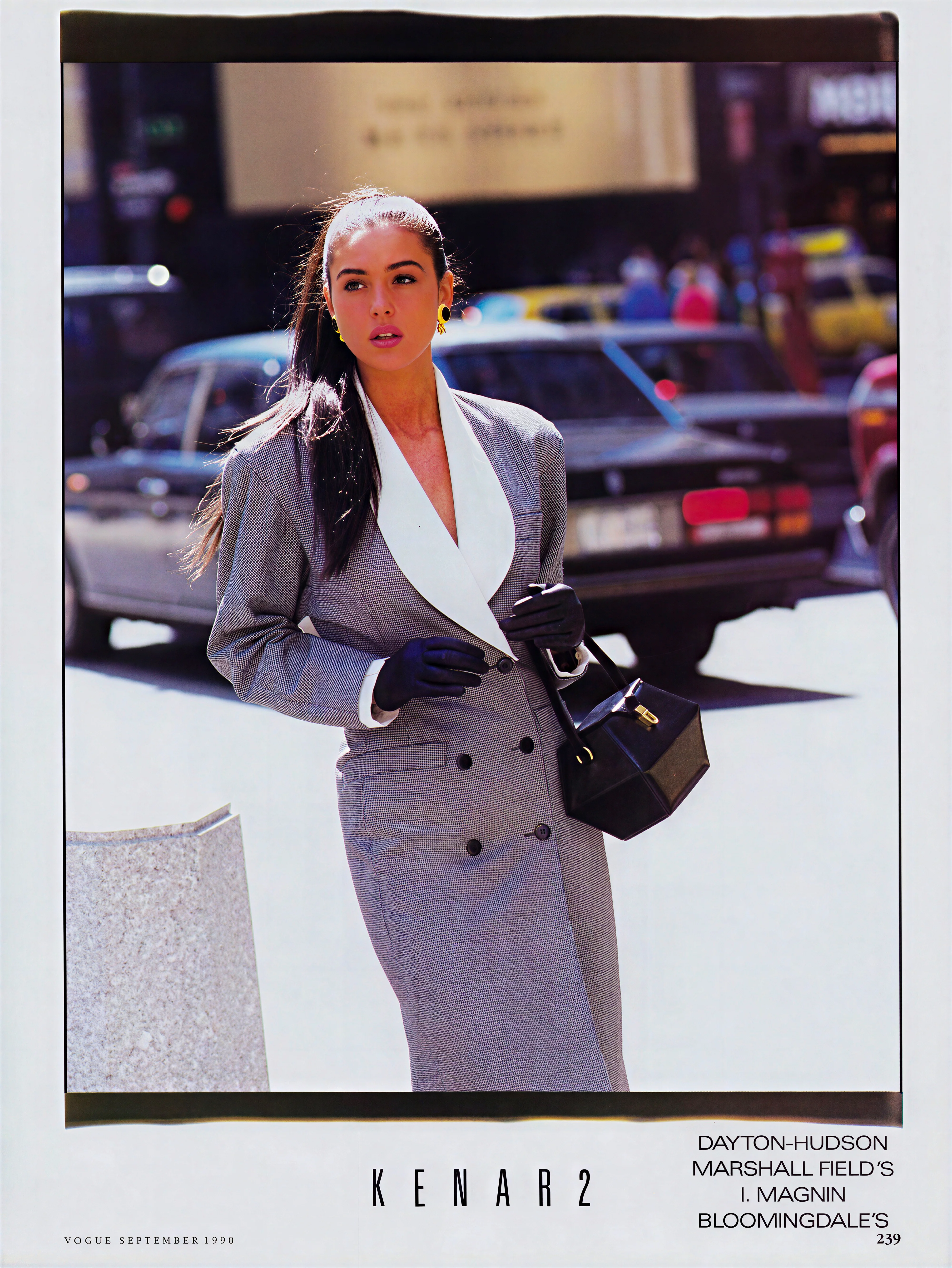
Kenar Enterprises was a Manhattan company that made better sportswear and dresses, tailored daywear for the women who shopped the better department-store floors, the kind of Seventh Avenue house that rarely gets a retrospective. It registered its first trademark in 1977 and was co-founded by Ann Tjian, a designer born in Shanghai whose name now survives mostly as a footnote in a Staten Island museum record. The man who ran it was Kenneth Zimmerman, and his real gift wasn't tailoring but casting.
The formula was one face, made enormous. Bellucci fronted the campaigns around 1990; then Linda Evangelista took over for most of the decade, and Kenar built her into something closer to a logo than a model. The ads ran as moving billboards through Manhattan and as a fixed presence in Times Square, several of them made with the agency Laspata DeCaro. One tied itself to Ads Against AIDS and seated Evangelista among seven older Sicilian women, an image a New York Post columnist nicknamed "Beauty and the Seven Beasts"; prints sold for a thousand dollars each. A 1992 campaign went further, an empty chair standing in for a family member lost to AIDS, unusually forthright for a clothing label then. Another ad had Evangelista kissing a male version of herself. Zimmerman said it plainly: "Linda was our Michael Jordan."
The trouble with buying a star is that you then have to stay big enough to keep her. A single face across Times Square is a fixed cost, and carrying it meant Kenar had to keep getting bigger. It opened stores in Manhattan, in the Hamptons, a few abroad, and split into a spread of small divisions Zimmerman later called plentiful but unfocused. Advertising that many little labels is a rich company's game. "I overexpanded," he told Women's Wear Daily. "I'm not a Liz Claiborne. I'm a private company." In September 1998 Kenar filed for Chapter 11, still budgeting three and a half million dollars for its fall campaign, still trying to advertise its way back to a size it had only briefly held.
None of that had happened yet on the September page. Bellucci is just walking, gloves on, bag in hand, the traffic gone soft behind her, the whole company still small enough to sit at the bottom of the frame in wide capital letters.
Sources:
-
Deep Dive 03: Ann Tjian for Kenar — Rabbit Fur Coat
-
Linda Evangelista — Wikipedia
-
Kenar to Consolidate Sportswear, Dresses Into a Single Division — Women's Wear Daily
-
Metro Business; Kenar Files for Chapter 11 — The New York Times
Filed under Kenar · Linda Evangelista · Monica Bellucci
This post is timestamped using Blockchain technology. Verify