Penny for the Guy, 1970
Laura Dale was seven when George Churchill photographed her towing her Guy along a London pavement in 1970, a glass jar in one hand and a length of string in the other. The caption that travels with the picture reads “Rattling her can: Laura Dale, seven, from Hampstead, pulls a pram chassis with a guy collecting for Bonfire Night in 1970”, which is nearly right. It isn’t a can. It’s a glass jar, empty or close to it, and she’s swinging it towards the camera as if Churchill might be good for a coin.
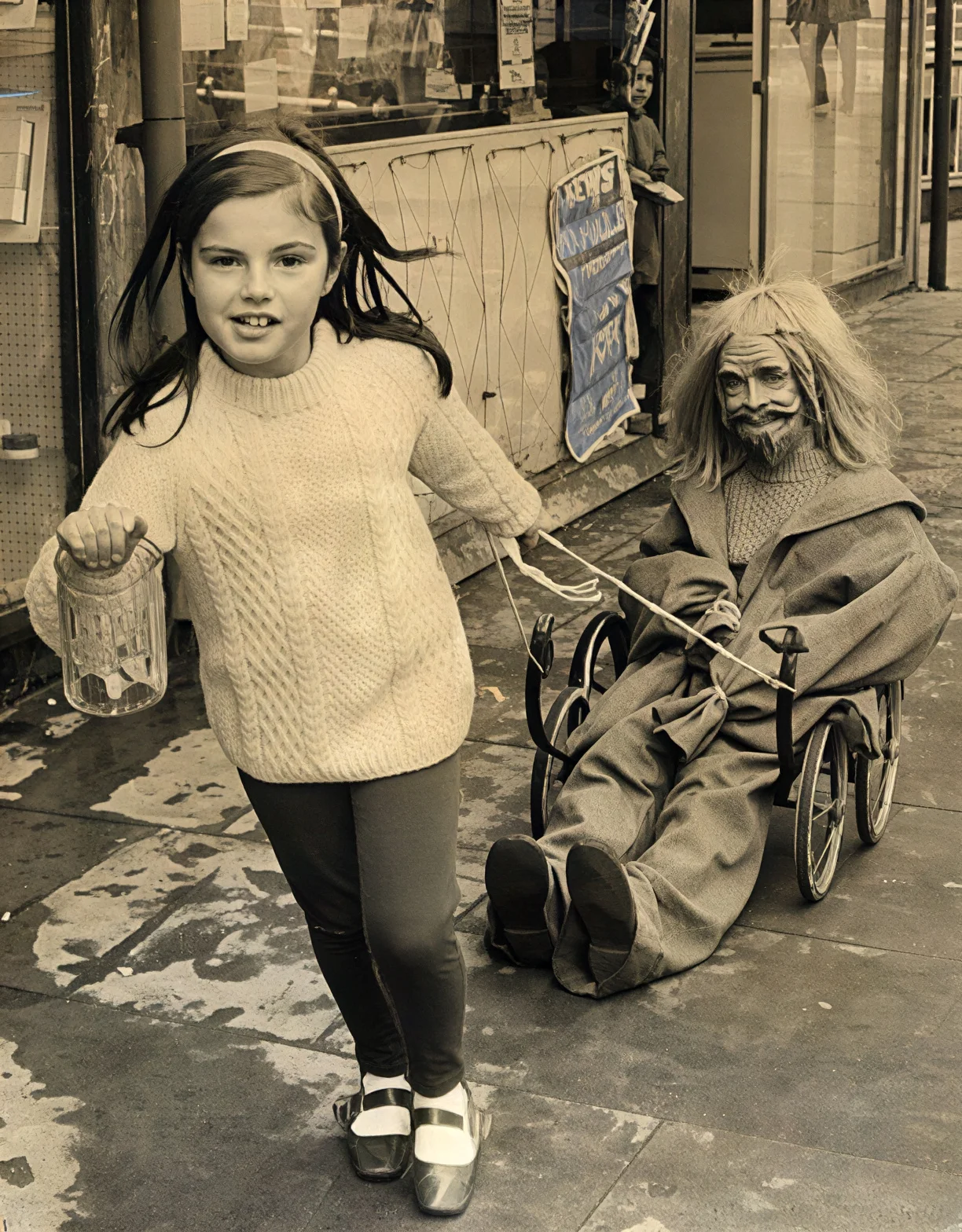
The Guy rides in what’s left of a pram, the body long gone and only the frame and its spoked wheels remaining, and he’s better dressed than you’d expect: a roll-neck jumper under a heavy coat tied at the waist with string, and a pair of real shoes at the end of his legs. His face is the strange part. Someone has painted it with real care, the curled moustache and pointed beard of every schoolbook Fawkes, and then topped it with a mop of pale, straggling hair that looks like unravelled rope. He sits slumped and patient, like an old man being taken out for an airing. Laura is all movement by comparison, hair flying, a woollen jumper too big for her, an Alice band, white socks and patent shoes. Behind her, half hidden in a shop doorway, another child is watching.
I should say which of those details I trust. The copy I found was 306 pixels wide, so I ran it through Topaz’s Wonder 4 to enlarge it fourfold, and software like that doesn’t recover detail so much as guess at it. The jar, the painted face and the child in the doorway are all there in the small original. The cables of the jumper and the weave of the Guy’s coat are mostly the software’s best estimate, which means I’ve been studying the incidental details of 1970 with an almost archaeological fascination when some of the artefacts are reconstructions.
Nothing in the picture has been arranged to look picturesque. The pavement is blotched and stained, the shopfront is scuffed, and the window is crowded with handwritten cards and notices, the kind of window that once did the work of a local noticeboard. A newspaper bill hangs from the frame, and the whole enterprise has the cheerful untidiness of an ordinary English afternoon in autumn, with none of the faint menace that so much seventies imagery seems to pick up at this distance.
The custom itself has gone. The London Museum’s page on penny for the Guy sets out the routine: children stuffed old clothes or pillows into a figure, took it round the neighbourhood “often in a pram or wheelbarrow”, and asked people for money. In theory the money bought fireworks, though “more often than not, it was just kept as pocket money”, which I find entirely believable. Then the Guy went on the bonfire. Effigies of Fawkes have burned since at least 1790, and before that it was the Pope, a piece of history nobody mentioned to me when I was seven. Henry Grant photographed the custom across London from the 1950s to the 1970s, so Churchill’s picture is one of a great many, but the Grant photographs on the museum’s page show children in groups, gathered round their Guys, where Laura is caught mid-stride. By the end of the century the tradition had faded out, and nowadays, as the museum puts it, it’s trick-or-treating that sends children onto the streets, “asking for sweets, not cash”. Even the cash was about to change. Decimal Day came on 15 February 1971, so the pennies Laura was asking for were the old ones, with a few months left to run.
Laura is entirely at home in a world that now seems almost as remote as Victorian England, and the age of the photograph isn’t the reason. The reason is how much of what she takes for granted went in such a short space of time: the old money, the bonfire built in the street or the back garden rather than at an organised display, and the idea of making a man from old clothes, wheeling him round the shops for coins and then setting him alight.
She couldn’t have known any of this. On the afternoon itself she was most likely thinking about the jar and whether it would fill, and about fireworks, and the melancholy only arrives from our side of the photograph, more than half a century later, where her quick, noisy afternoon has gone still. The Guy, presumably, went on a bonfire a few days afterwards.
Sources:
-
Penny for the Guy?: A lost Bonfire Night tradition — London Museum
-
Throwback Thursday — Dobbin’s Bobbins
-
Gunpowder, Treason and Plot! — Hidden Highgate
-
Decimal Day — Wikipedia
Filed under Hauntology & the uncanny
This post is timestamped using Blockchain technology. Verify