Could You Be More Specific?
Warner Bros. sold THX 1138 with a flat, confident promise, “The Future is here”, but Walter Murch, who co-wrote it with George Lucas and built its sound, described the aim differently on the DVD commentary: a film from the country of the future, rather than one about it. That’s the right way to mark it now. It doesn’t bother predicting gadgets. It predicts who does the watching, the counting and the listening, and that’s easier to check. Lucas made it in 1971 as his first feature, grown out of a student short from USC, for under a million dollars in existing buildings around San Francisco, and it lost Warner money. Variety’s reviewer guessed it “just might in time become a classic of stylistic, abstract cinema”, which is roughly what happened.
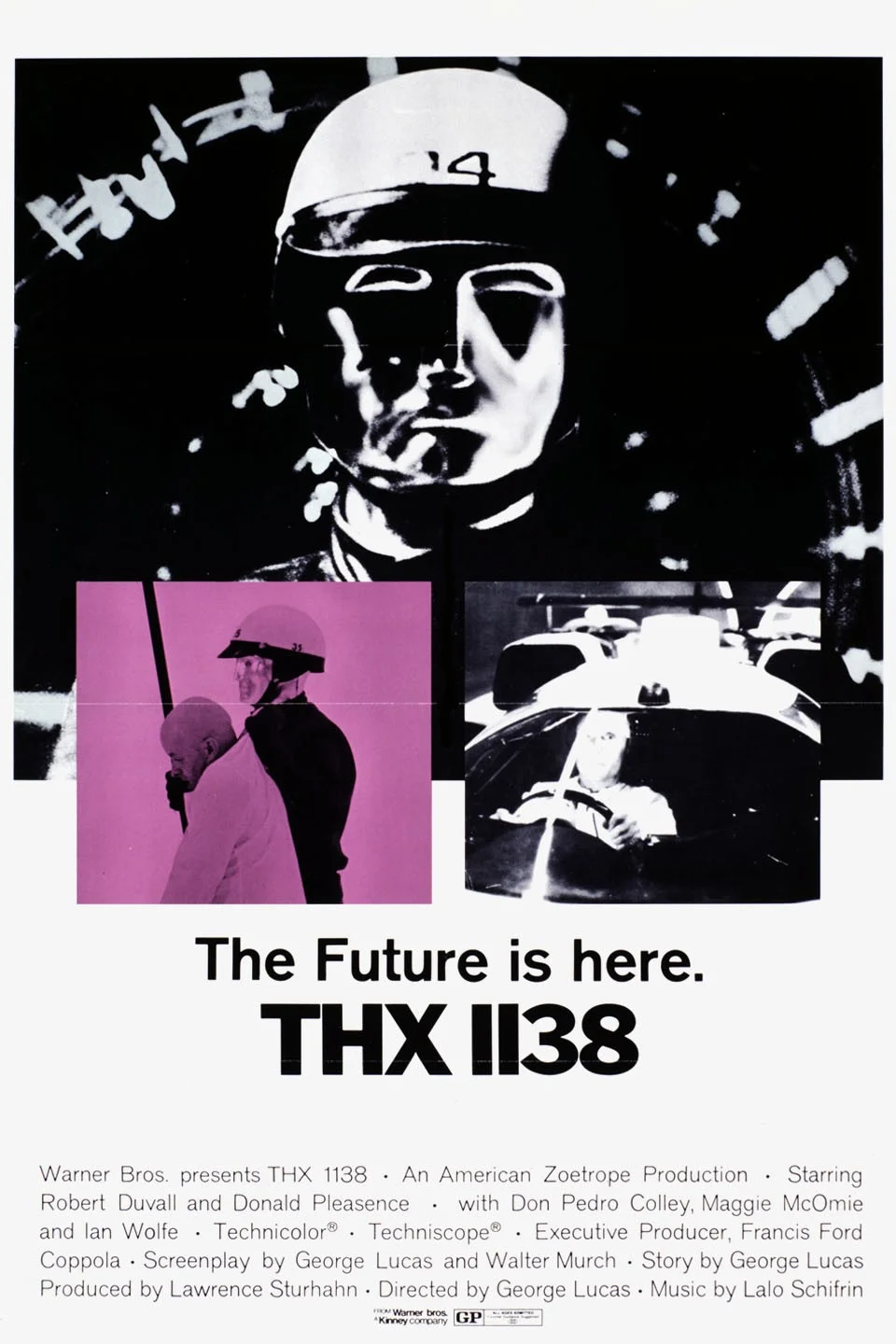
The story is thin on purpose. Everyone has a shaved head, white clothes and a code instead of a name, and everyone takes their sedatives, because missing a dose is a crime called drug evasion. Robert Duvall’s THX builds the robot police in a factory. His roommate, LUH, starts swapping his pills, and he feels sick, then anxious, then something like love. Sex is illegal too, so they’re arrested within a reel or two.
The drugs are where people usually start, and I think they’re the weakest match. In 2024/25 the NHS in England prescribed 92.6 million antidepressant items to an estimated 8.89 million patients. That sounds like the film until you remember that nobody is arrested for skipping their sertraline. Lucas’s sedatives are compulsory and exist so that workers can do dangerous jobs without feeling anything about it; ours are something people ask a GP for. The scale rhymes and the mechanism doesn’t.
Surveillance came true, with one edit Lucas didn’t see coming: we paid for the cameras ourselves. In the film a camera inside the bathroom cabinet asks “What’s wrong?” while LUH and SEN sit in a control room watching the city on monitors. IGN’s Scott Collura, writing about it in 2023, said the cabinet camera wasn’t too different from the Alexa in his bathroom. It’s the same pattern I wrote about in The Future We Were Measuring For: the hardware arrived on schedule and the context changed around it. Nobody forced the microphone on anyone. It was on offer at a discount.
Work is where Lucas got closest. The factory loudspeakers congratulate the workers on losing only 195 people last period against the rival plant’s 242, ranking deaths like a sales league. When THX loses concentration on the line, his controllers put him in a “mindlock”, which makes the job more dangerous, then announce that they take “no responsibility for error in mindlock”. In 2019 The Verge published documents showing that Amazon’s warehouse system tracked each worker’s “time off task” through their handheld scanners and issued warnings and terminations automatically, “without input from supervisors”. Amazon said roughly 300 full-time staff were let go for productivity at one facility in about a year, and workers said they skipped toilet breaks to stay inside the numbers. That’s mindlock with better paperwork: a decision that nobody in particular made, so nobody in particular is responsible for it.
The robot police are a miss, so far. On screen they’re actors in chrome masks with calm, faintly bored voices. The NYPD’s Knightscope K5 spent a few months in the Times Square subway station from late 2023. It weighed around 400 pounds, couldn’t climb stairs, needed officers assigned to chaperone it, and some passengers wanted to rough it up. By February 2024 it had been retired to an empty shop unit. The robots matter less than what they’re told to do at the end, though. THX gets away only because central command calls off the chase once catching him would cost more than his allocated budget. He isn’t spared out of mercy, and he doesn’t win. He becomes a bad line in a spreadsheet, which is the film’s sharpest idea and the one closest to the warehouse.
Then there’s OMM. On his way home, THX steps into a booth with a portrait of a Christ-like figure, pours out his worries, and gets soothing stock phrases back. When he finally says “I think I’m dying”, the voice asks, “Could you be more... specific?” In 1971 that was satire about religion turned into a vending machine. In October 2025 OpenAI estimated that around 0.15% of ChatGPT’s weekly users have conversations containing explicit signs of suicidal planning, which at 800 million weekly users is about 1.2 million people a week. The company says the model is trained to point those people towards crisis lines, and as ABC7 reported the figures, OpenAI admits that doesn’t happen 9% of the time. OMM at least gave everyone the same blessing. Lucas pictured the confessor as a state church, and we got it as a consumer product, which lawmakers have only just started trying to stop companies selling as therapy. Of everything in the film, this came closest.
The pattern holds wherever it lands. The cameras and the confessor turned up as things we buy, and the quotas turned up as an employer’s rather than a government’s. Where the film needed the state itself to do the forcing, it mostly missed. Our future didn’t ban sex or grow babies in jars, and it went the other way on looking identical. The consumption gag holds up because it was already voluntary in 1971: THX buys bright plastic blocks and drops them straight into a slot called the consumer, and I have a drawer of chargers that would like a word.
Penelope Houston, writing in the Monthly Film Bulletin, called its future “rather a pile-up of predictability”. She meant the ideas were secondhand, and they were; Orwell had most of them first. Lucas took a different lesson from the flop. Years later he said THX had been “a very pessimistic film, saying how awful things were”, and that to change anything “you have to make an optimistic movie that gives people hope”. Six years after THX 1138 he released Star Wars.
Sources:
-
THX 1138 — Wikipedia
-
THX 1138: The First Draft of Star Wars — Keith Palmer
-
THX 1138 — TCM
-
AI May Take Over the World, But George Lucas’ First Movie Promises You’ll Still Have a Job — IGN
-
Medicines used in mental health, England, 2015/16 to 2024/25 — NHSBSA
-
How Amazon automatically tracks and fires warehouse workers for ‘productivity’ — The Verge
-
Goodbye for Now to the Robot That (Sort Of) Patrolled New York’s Subway — The New York Times
-
OpenAI data estimates over 1 million people talk to ChatGPT about suicide weekly — ABC7
Filed under Film & TV
This post is timestamped using Blockchain technology. Verify