Have You Found the Yellow Sign?
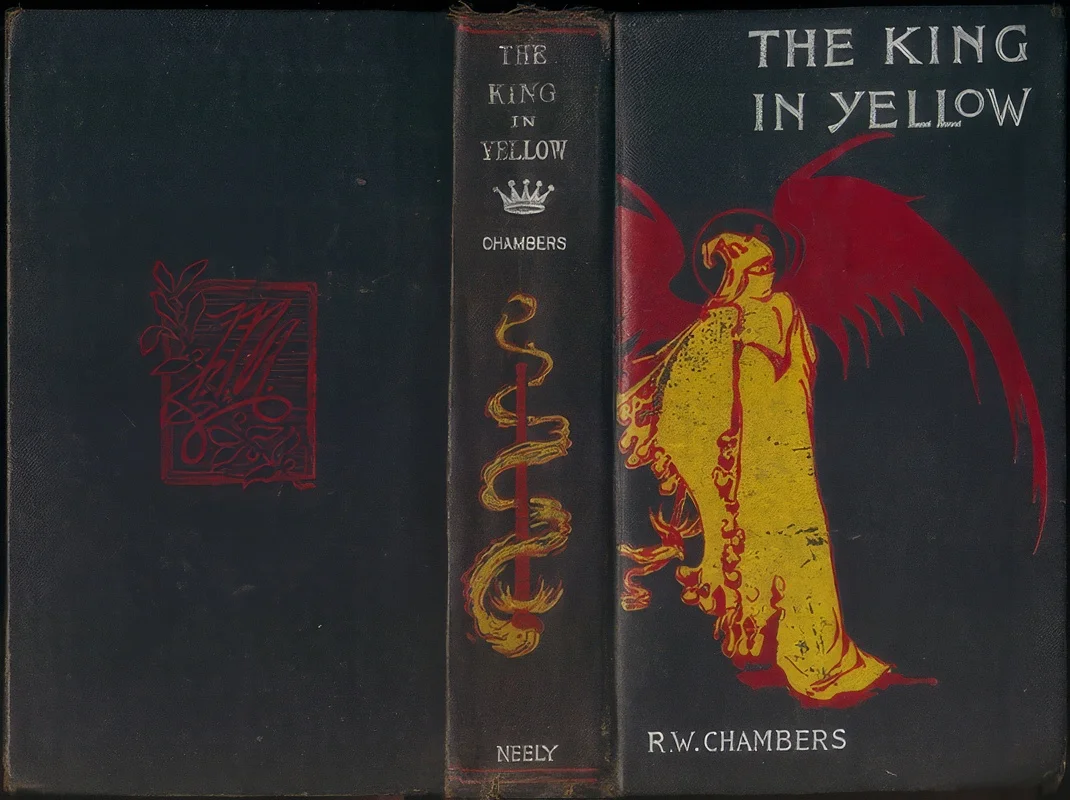
The cover gives away more than the book ever does. On the Neely edition's black cloth there he is, a robed yellow figure with red wings and a halo that looks more like a warning than a blessing, while inside, Robert W. Chambers never lets you see him at all. Booksellers call this binding the Yellow King cover and list it as a third printing of the 1895 first edition; the earliest copies went out in green cloth. Chambers was about thirty, back from seven years of art school in Paris, and he'd been selling illustrations to Life and Vogue before he turned to fiction. The cover is the first attempt anyone made to picture the King, and it's handsome and not remotely frightening, which is the whole problem in miniature.
The book is odder than its reputation suggests. It holds nine stories and a sequence of poems, and only the first four deal with the thing everyone remembers: a play, also called The King in Yellow, whose first act is harmless and whose second act drives anyone who reads it mad. Chambers never gives us the second act. He gives us an epigraph instead, Cassilda's Song, and it does more work than a hundred pages of description would:
Along the shore the cloud waves break, The twin suns sink behind the lake, The shadows lengthen In Carcosa.
After those four stories the collection drifts into Paris studio life and romance. "The Demoiselle d'Ys" keeps one supernatural time slip, borrowed in spirit from Gautier, and by the end the horror has simply left the room. The change of tone hits like a missed stair. It reads like a man deciding, halfway through a book, what kind of writer he's going to be.
Even the vocabulary is borrowed. Carcosa comes from Ambrose Bierce's "An Inhabitant of Carcosa" (1886), and Hastur from Bierce's "Haïta the Shepherd" (1891), where he's a gentle god of shepherds. Chambers seems to have liked the sound of the names and not much else. In "The Repairer of Reputations" Hastur turns up alongside the Hyades and Aldebaran, as though it were a place, and nobody tells you which reading is right. That refusal is the whole method, and it's the thing every later writer would be tempted to fix. The story itself is still the strongest of the four. It's set in a future America where, from April 1920, a white Government Lethal Chamber stands open on Washington Square for anyone tired of living, and it's narrated by Hildred Castaigne, who has read the play and believes he's the rightful king of it all. You can never quite tell how much of his New York is real. "The Yellow Sign" does something simpler and nastier with a churchyard watchman whose face suggests a plump white grave-worm and who keeps asking the same question: "Have you found the Yellow Sign?"
Chambers made the choice for good. He turned to romances and historical novels, and by most estimates had one of the most successful literary careers of his period, with several best-sellers and a run of silent-film adaptations around 1920. H. P. Lovecraft, who read The King in Yellow in early 1927, put the regret plainly in Supernatural Horror in Literature: "One cannot help regretting that he did not further develop a vein in which he could so easily have become a recognised master." That essay is part of the reason the early weird fiction stayed in print through most of the twentieth century while the best-sellers faded. Lin Carter later called the book "probably the single greatest book of weird fantasy written in this country between the death of Poe and the rise of Lovecraft," and critics from E. F. Bleiler to S. T. Joshi to T. E. D. Klein have treated it as a classic. The Los Angeles Review of Books calls Chambers "practically the Harper Lee of horror", which is fair for a reputation resting on four stories and a poem cycle.
Lovecraft handled the material lightly. He dropped the Lake of Hali, Hastur and the Yellow Sign into a list of dread names in "The Whisperer in Darkness" (1931), in passing, the way you'd nod to a friend across a room. August Derleth is where it goes wrong. He developed Hastur into a Great Old One, spawn of Yog-Sothoth and half-brother to Cthulhu, which is exactly the family tree Chambers had declined to draw. Along the way Hastur, a name Chambers left floating somewhere between god and place, got fused with the King himself, and Hastur's reference entry now lists eight epithets, from The Unspeakable One and The King in Yellow to Xastur and Kaiwan, for a figure Chambers never once described. It's a filing system. Once the King has a genealogy, he stops being a rumour and becomes an entry. Chaosium, the publisher of the Call of Cthulhu role-playing game, kept the name circulating into the nineties, publishing Robert M. Price's anthology The Hastur Cycle in 1993, and by then the King was something you could roll dice against.
The second wave arrived in January 2014 with the first season of True Detective. Nic Pizzolatto's Louisiana is full of spirals carved into victims and murmured references to Carcosa and the Yellow King, and it sent a lot of viewers hunting for a play that was never written because it was never real. For most of its eight episodes the show understood Chambers better than Derleth did. Then the finale gave Carcosa a physical address, a derelict fort in the backwoods, and the Yellow King turned out to be a man with a grudge and a lawnmower. It's a fine ending for a crime drama and a poor one for the King.
Some of the best work since has taken Chambers's side. Signalis, the 2022 survival-horror game, keeps the play sealed for its protagonist until the very end and builds the game around the waiting, which is his trick moved into a medium that usually rewards you for opening everything. A YouTube video called Searching For a World That Doesn't Exist, which a student reporter credits with a resurgence of interest in the book, held people, in the reporter's reading, because it refuses to explain itself and nothing ever confirms the theories it sets off. Chambers got there first, then went off to write romances and left the second act for everyone else to not write. You can read the whole book free at Project Gutenberg. The first act, anyway.
Sources:
-
The King in Yellow — Wikipedia
-
Robert W. Chambers — Wikipedia
-
Hastur — Wikipedia
-
The Secret Chambers of the Heart: Robert W. Chambers and "The King in Yellow" — Los Angeles Review of Books
-
The Cultural Relevance of The King in Yellow — The Science Survey
-
The King in Yellow — Project Gutenberg
Filed under Books & writing
This post is timestamped using Blockchain technology. Verify