Parnag Fegg Isn't Real
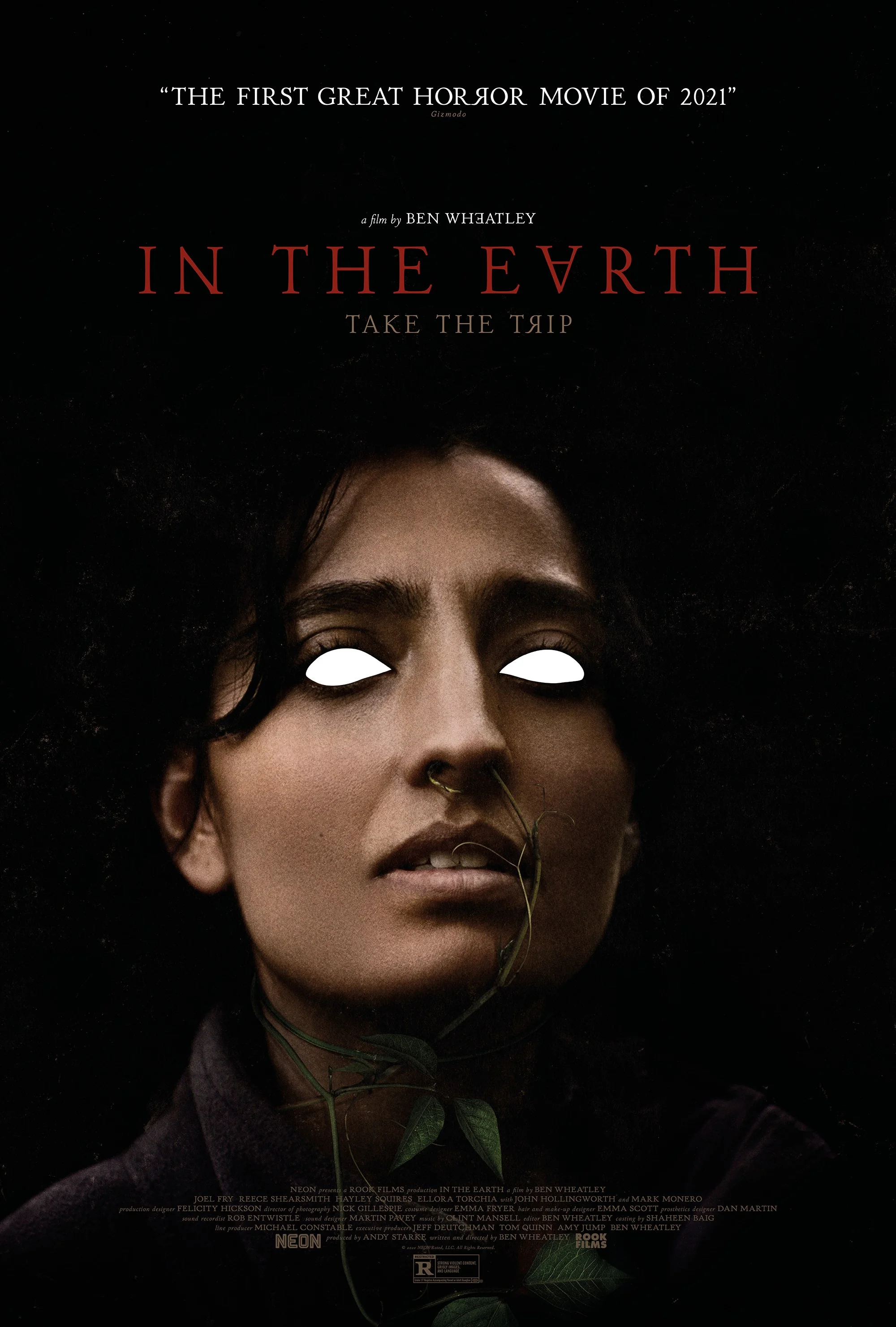
Neon’s poster for Ben Wheatley’s In the Earth shows a woman with blank white eyes and a vine in her nostril, its stem trailing over her lips and down her throat. Someone tampered with the lettering as well. There’s a backwards R in “horror” and another in the tagline, “Take the trip,” and the A in the title is turned upside down, so the type looks wrong a second before you work out why. Above all of it runs a line from Gizmodo calling the film “the first great horror movie of 2021.”
Most of the film was shaped by what 2020 allowed. Wheatley told Sight & Sound that he started writing it in the second week of the UK lockdown, “trying to process what I was feeling about what was going on,” and by August he was shooting it, in fifteen days. Indoor Covid protocols were “too onerous and expensive,” he explained to The Hollywood Reporter, so the forest was as much a practical choice as an artistic one, and even out there, protective equipment became the thing they spent the most money on. Part of the inspiration was Halloween. He’d found its production paperwork online, and John Carpenter’s schedule had run only two or three days longer than his.
The story stays small. A scientist, Martin (Joel Fry), and a park scout, Alma (Ellora Torchia), hike into a restricted forest to find a colleague, Dr Olivia Wendle (Hayley Squires), who has gone quiet after months of research out there. On the way they meet Zach (Reece Shearsmith), a helpful-seeming stranger with stories about a woodland spirit called Parnag Fegg. Going by Rolling Stone’s review, the second half turns into strobes and a droning, feedback-heavy soundtrack, under lighting “heavy on rotting greens and Bava-worthy reds,” with Clint Mansell writing the score.
Wheatley pushed back on the label “pandemic film.” “It wasn’t a subplot; it’s just set in the now,” he told io9. In lockdown he’d watched new releases arrive on streaming and found they “all looked like period pieces now,” full of crowds. For a while any packed bar on screen looked like archive footage to me too, and a script that ignored the previous year would have been its own kind of fantasy.
Fantasy is the other thing the film is about. Wheatley told Sight & Sound it isn’t straight folk horror but “a conversation with the genre,” and that Zach has invented the whole mythology: “Parnag Fegg is not real, none of it is real.” The idea grew out of watching British and American politics and thinking about “the erosion of fact, and this weaponising of narrative,” people using stories to push their own version of reality. Zach’s stories are fabricated, but Wheatley doesn’t pretend that leaves the woods empty. “The thing in the woods makes its own decision,” he said, and it chooses “someone who isn’t a narrative maker,” someone practical who is more likely to understand what it wants. The folklore is fake and the forest isn’t, which I find far stranger than any spirit Zach could have dreamed up.
Sources:
-
In the Earth — Wikipedia
-
“I wanted to make something that fits the moment”: Ben Wheatley on In the Earth — Sight & Sound
-
Ben Wheatley on Why Pandemic-Shot Horror Film ‘In the Earth’ Was His “Rock to Hold On To” During Lockdown — The Hollywood Reporter
-
‘In the Earth’ Review: Ben Wheatley’s Pandemic-Psychedelic Horrorshow — Rolling Stone
-
REVIEW: In the Earth (2021) dir. Ben Wheatley — Boston Hassle
-
In the Earth’s Ben Wheatley on Folk Horror and Post-Pandemic Storytelling — io9
Filed under Film & TV
This post is timestamped using Blockchain technology. Verify