Twenty-Five Septembers
The ceremony at the World Trade Center site has kept the same six times for twenty-four years. American Airlines Flight 11 hit the North Tower at 8:46, New York time, and United Airlines Flight 175 went into the South Tower at 9:03. American 77 struck the Pentagon at 9:37. The South Tower collapsed at 9:59, United 93 came down in a field near Shanksville, Pennsylvania, four minutes after that, and the North Tower fell at 10:28. Everything from the first impact to the last collapse took an hour and forty-two minutes. This year a seventh moment of silence joins them, observed after the names have been read, for people who lost their lives in the years since to illness and injury tied to that day. It isn’t pinned to any minute on the clock.
The death toll that morning was 2,977, among them 343 firefighters. Family members reading on the memorial plaza today will get through 2,983 names, because the list also carries the six people killed in the February 1993 bombing of the same towers. The remains of more than a thousand of the dead have never been identified. On Flight 93, the forty passengers and crew fought back against the hijackers and tried to retake the plane.
The historian David Blight, who spent several years on an informal group advising the museum’s curators, calls it the “most filmed and visualized event in history,” and thinks it may still be awaiting its modern Euripides. I suspect those two things are connected, though I can’t prove it. When most of the world meets an event as footage, art arrives second, trying to add something to pictures everyone has already seen. The museum’s exhibition this year on comic books and 9/11 starts from a version of the same problem: the attack sites saw “no fictional superheroes come to the rescue, only real people helping however they could.” Even the name reached Britain from somewhere else. Here the date is written 11/9, day before month, and almost nobody calls it that. The American order crossed the Atlantic and stayed.
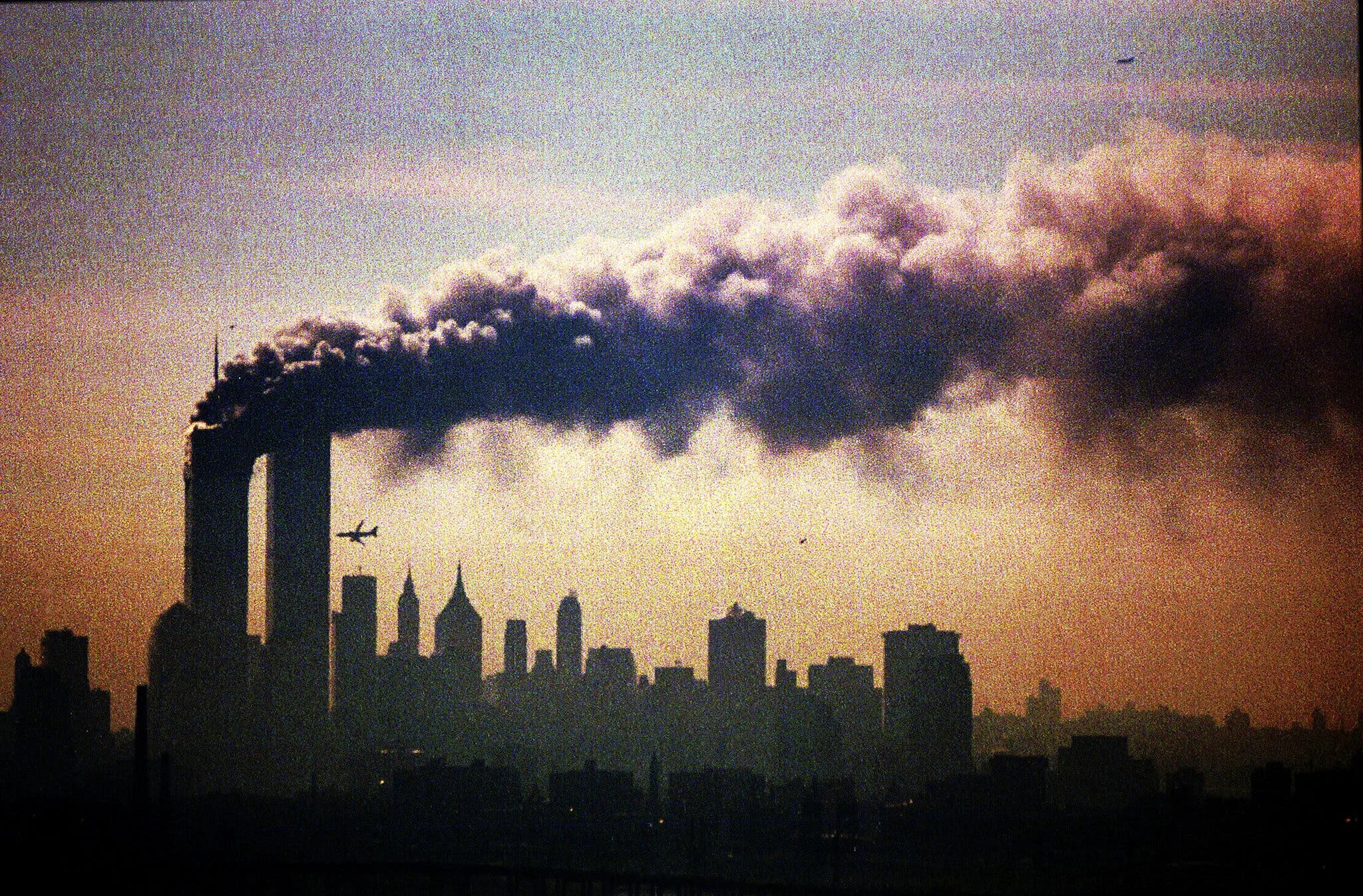
The first cultural reflex was to take the towers out. Radio stations dropped songs from their playlists, and a Simpsons episode set largely at and inside the World Trade Center was removed from syndication. Sidewalks of New York, People I Know and Spider-Man had their releases delayed so producers could cut scenes that showed the buildings, and Kissing Jessica Stein was modified before release for the same reason. Meanwhile, as the city cleared the wreckage, an engineer walked through the rubble spray-painting SAVE on objects that ought to be kept. Part of that was practical, since investigators needed to understand why the towers came down, but Alice Greenwald, who became the museum’s founding director, told Gothamist there was also “a sense of history” behind it. Both reflexes still look decent to me. Cutting spared people a picture of what they’d lost, and the spray can made sure the physical evidence of it survived.
“Never Forget” began on paper. Nazia Kazi, who teaches the history of the war on terror at Stockton University, traces it to the missing-person posters that went up on lampposts and scaffolding across the city, which memorial posters gradually replaced. Her description of what it became afterwards is “a slogan, a brand name,” and I think brand is exactly the right word. The posters changed slowly, but as Gothamist puts it, the phrase’s meaning was “almost immediately complicated” by what followed: the wars, mass surveillance, the arrests and deportations, and a new chapter of Islamophobia. A brand can be attached to almost anything, and over twenty-five years this one has been attached to a great deal.
George W. Bush declared a global war on terror on September 20, 2001, and no president since has declared it over, a point Jill Lepore makes in her New Yorker essay this month. The US went to war in Afghanistan that October and stayed for twenty years, and the Iraq War began in 2003. Some of the families pressed for a fuller account of 9/11, and their efforts led to the 9/11 Commission Report, published in 2004, which held no one in the US government responsible for the intelligence lapses that failed to stop the hijackings. Brown University’s Costs of War project counts at least 940,000 people killed by direct violence in the post-9/11 wars, among them civilians, armed forces on all sides, contractors, journalists and aid workers.
Building the museum meant deciding where the story starts. Blight remembers the curators facing the question of whether to represent only the twenty-four hours of September 11 or tell “a much longer story of the causes and consequences.” It opened in 2014, beneath where the towers stood, with some of what had been saved inside. Steve Kandell, whose sister Shari was among the unidentified, was an early visitor. He wrote about artifacts ranging from “the husk of an ambulance” to “handwritten pleas for help” and “dusty, ownerless Topsiders encased in glass,” and put the whole experience into one sentence: “Everyone should have a museum dedicated to the worst day of their life and be forced to attend it with a bunch of tourists from Denmark.” It’s bitter, and funny in the way only someone with the right to say it can be funny.
About half of American adults remember September 11 as the most historic event of their lifetime, according to a poll the Associated Press reported this week, but the museum reckons 100 million Americans are too young to remember it at all. Every graduating FDNY and NYPD class now spends part of its final week there. Dedie Plasencia, a firefighter at Engine 240 in Windsor Terrace, Brooklyn, who is retiring in February, runs his own version of the lesson. Every so often he sits the newer crew down in front of footage shot downtown that morning by filmmakers who happened to be following a probationary firefighter. He has moved it from videocassette to disc, and soon he’ll have to move it again, onto a thumb drive. For many people, Gothamist notes, “Never Forget” can’t mean what it means for Plasencia. “The only way for them to really feel it like I do,” he said, “is to be detailed.”
Hauntology is a word for the way lost futures linger in culture, and it gets precious fast when the ghosts had names, so these are only notes. In the late summer of 2001, William Basinski was digitising old tape loops, and the tape was coming apart as it played, shedding a little of itself on every pass so the music thinned and dropped away while he recorded it. He finished on the morning of September 11. That evening, from a friend’s rooftop, he filmed the smoke still moving over the city, and stills from that footage became the covers of The Disintegration Loops, which he dedicated to the victims. A version now plays in the museum’s historical exhibition alongside the film, a pairing that Lindsay Balfour, in an essay on the loops, says has an almost architectural effect, “giving structure back to the towers.” If the day is still waiting for its Euripides, this is the nearest thing I know, and I think that’s because it never tried to get out from under the footage.
The films trimmed in 2001 were exceptions, and plenty of others shot in New York before that September still have the towers in them, in establishing shots and behind conversations that had nothing to do with them. The frames nobody cut are the stranger ones now, because they couldn’t have known what they were recording, and we can’t stop knowing. Angus K. Gillespie’s history of the buildings is strange in a different way. Rutgers University Press published it in 1999 as Twin Towers: The Life of New York City’s World Trade Center, a biography of two buildings finished while its subjects were still standing.
The memorial holds both of those first reflexes at once. On the plaza, two pools sit in the footprints of the towers, so the site is organised around an absence, while the museum beneath it keeps what was saved. Tribute in Light, first switched on six months after the attacks and back every September 11 since, sends two beams up over Lower Manhattan to stand in for the buildings, about as close as public art gets to presence without substance. They go up again tonight.
Greenwald remembers one of her advisers putting it starkly: ground zero is where the 21st century began. Mark Fisher argued that the future had been cancelled well before that, somewhere in the 1980s. If they’re both right, the new century began with a subtraction, in a culture already living off its past, and it has spent twenty-five years arranged around the outline of what was taken away.
Sources:
-
9/11 at Twenty-Five — The New Yorker
-
25th Anniversary Commemoration — 9/11 Memorial & Museum
-
Marking the 25th Anniversary — 9/11 Memorial & Museum
-
How New Yorkers teach a generation removed to ‘Never Forget’ 9/11 — Gothamist
-
“Can These Bones Live?”: Reflections on the Anniversary of 9/11 — Just Security
-
9/11, 25 years on: For 100 million Americans, it’s not even a memory — The Straits Times
-
US marks 25 years since the Sept. 11 attacks, ‘moments that divide time’ — Associated Press via WSLS
-
Findings — Costs of War, Watson Institute, Brown University
-
September 11 attacks — Wikipedia
-
Cultural impact of the September 11 attacks — Wikipedia
-
The Disintegration Loops — Wikipedia
-
Traumatic Ruins and The Archeology of Sound — Research Catalogue
-
Twin Towers: The Life of New York City’s World Trade Center — Internet Archive
Filed under Hauntology & the uncanny
This post is timestamped using Blockchain technology. Verify