A Vamp Was Requested
Burn shy beauty at the stake, ANNA told its readers in the last week of 1988. The seduction of the moment calls for vamps, slightly diabolical, perfumed with passion, in love with ardent red. That is the brief, set in italic down the left of the page above the credits.
Giuseppe Pino was the wrong photographer for it and had been for about thirty years. Born in Milan in 1940, he landed on the Società Umanitaria’s photography course because the graphic design classes were full. He shot covers for the newsweekly Panorama from 1967 to 1974, went to New York for the jazz, ended up around Warhol’s Factory and in the pages of Interview, and put prints on Atlantic Records sleeves. He came back to Italy during the eighties and took advertising and fashion work. Being hired to do it and being interested in it are separate questions.
A memorial by someone who knew him has a young Anna Wintour trying to steer him toward fashion photography and getting nowhere: he was indifferent to clothes and didn’t understand them. He drew a line between the beautiful, silent photograph and the true, speaking one, and said that unless something happened between camera and subject you were only taking passport photos.
An opening spread where the garment is illegible proves nothing on its own. That is ordinary magazine grammar, and the merchandise turns up on the pages after. What’s odd here is narrower. Whatever the red is, hood or cape or collar, it arrives as a field of colour with no seam or cut in it, and the face it frames turns down the brief outright. Chin low, head back over one shoulder, mouth open slightly and slack, brows flat, the eyes coming up from under them and holding still. No arch, no snarl, nothing diabolical. It reads like someone who has been talked to rather than directed.
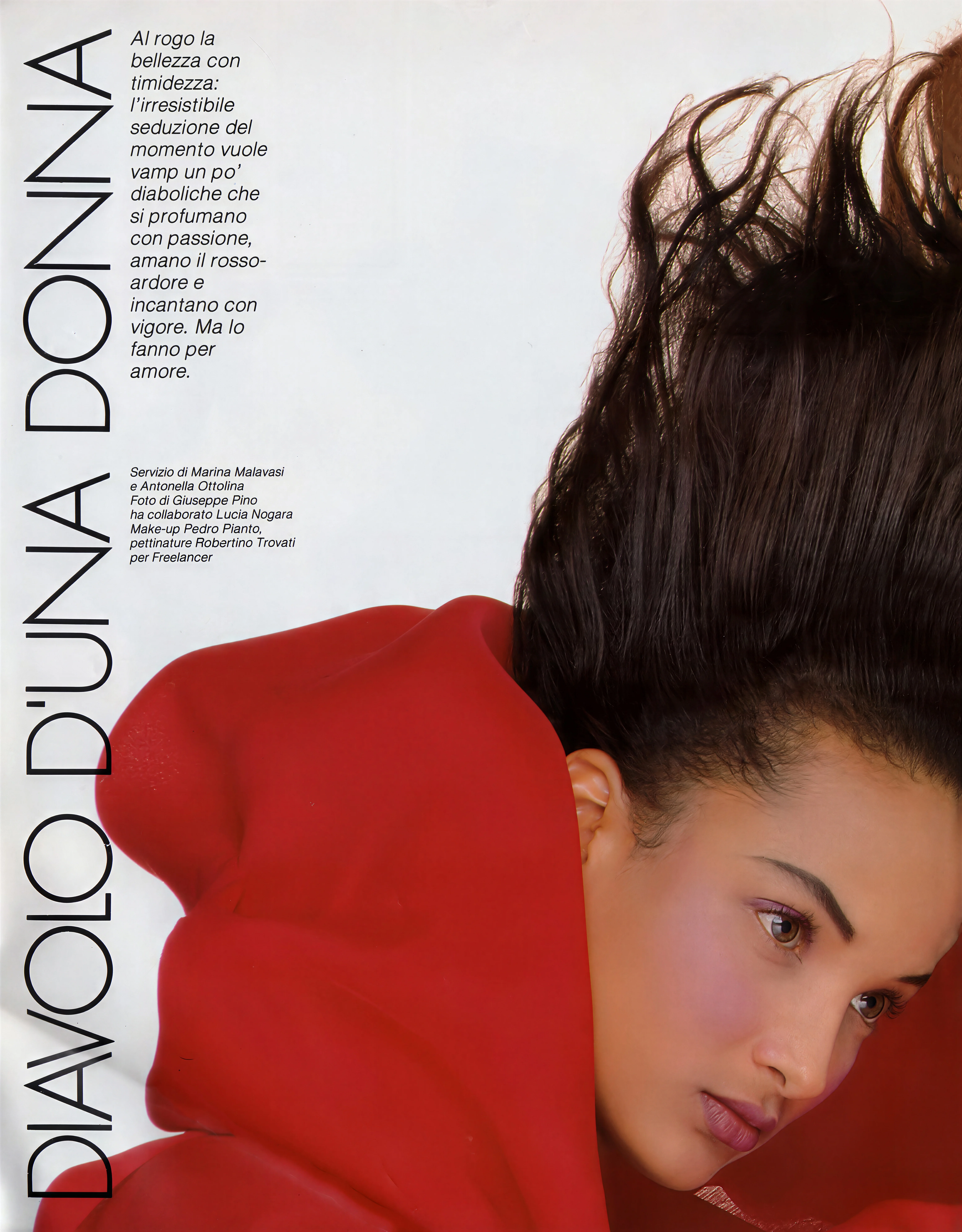
The face belongs to Jennifer Noble, born in New York to Jamaican parents, scouted at twelve and scouted again on the Piazza di Spagna while she was at university in Rome. Her father Gil Noble had been one of the first successful Black male models before he became an anchor at ABC, so she was the second generation in the family to work out what a lens wants.
Six names sit in the corner of the page: two stylists, make-up, hair, Pino, and one more whose job the credit never explains. All of them were there to move clothes in the Christmas-week number of a weekly. What went to press was a portrait.
Sources:
-
Meet Jennifer Noble, the Former Model Behind Parisian Accessories Boutique Iris Noble — Vogue
-
Giuseppe Pino. I Knew Him Well — AT Superstudio Magazine
-
Addio al fotografo Giuseppe Pino: dalle copertine di Panorama ai ritratti dei grandi del jazz — Il Denaro
-
Iris Noble, de top-modèle à créatrice de sacs de luxe — Le Point
-
Anna (magazine) — Wikipedia
Filed under Jennifer Noble
This post is timestamped using Blockchain technology. Verify