Before the Scissors
Linda Evangelista grew up in St. Catharines, Ontario, the middle child of Italian immigrants who had come from a small town in Lazio. Her father worked for General Motors, her mother kept books, and the house was strict enough that a teenage Linda had to choose one weekend night to go out and wasn’t allowed a boyfriend. She played street hockey with the neighbourhood boys, took tap and accordion, and taped torn-out magazine pages to her bedroom wall. The models on those pages didn’t even have names you could learn back then; they were printed in tiny type on the inside cover.
The modelling school she wanted cost too much, so her parents paid for self-improvement classes instead: poise, etiquette, how to do her own hair and makeup. At sixteen a Japanese agency offered her a summer contract, and to her surprise her parents let her go. It fell apart fast. Nobody met her at the airport, the apartment was filthy, and the agency wanted her undressed for “measurements” they already had. She called her mother, got herself to the Canadian embassy, and flew home swearing off the whole business. Two years passed before she tried again.
A scout from Elite spotted her at a Miss Teen Niagara pageant she didn’t win. In New York she met John Casablancas, who told her she looked like the model Joan Severance, whose picture Linda already had on her wall. In 1984 she moved into the models’ apartments, four girls to a room, and did eight or ten go-sees a day, learning the subway between appointments, her dark hair worn long down her back. Not much happened, so Elite sent her to Paris.
Paris was slow too. She picked up catalogues and a few editorials and her first real cover, L’Officiel, late in 1984, but the good jobs took three years. She stayed in the cheap hotels where the young models stayed and caught bed bugs in the one where Oscar Wilde died. She did midnight fittings for Karl Lagerfeld, who would keep her late trying on Poiret pieces he had bought at auction, for photographs he never meant to publish. In 1986 she met Steven Meisel, the photographer who would go on to build more of her image than anyone. Through all of it she kept that same long, heavy mane, banked high off the face, the exact look she was about to throw away.
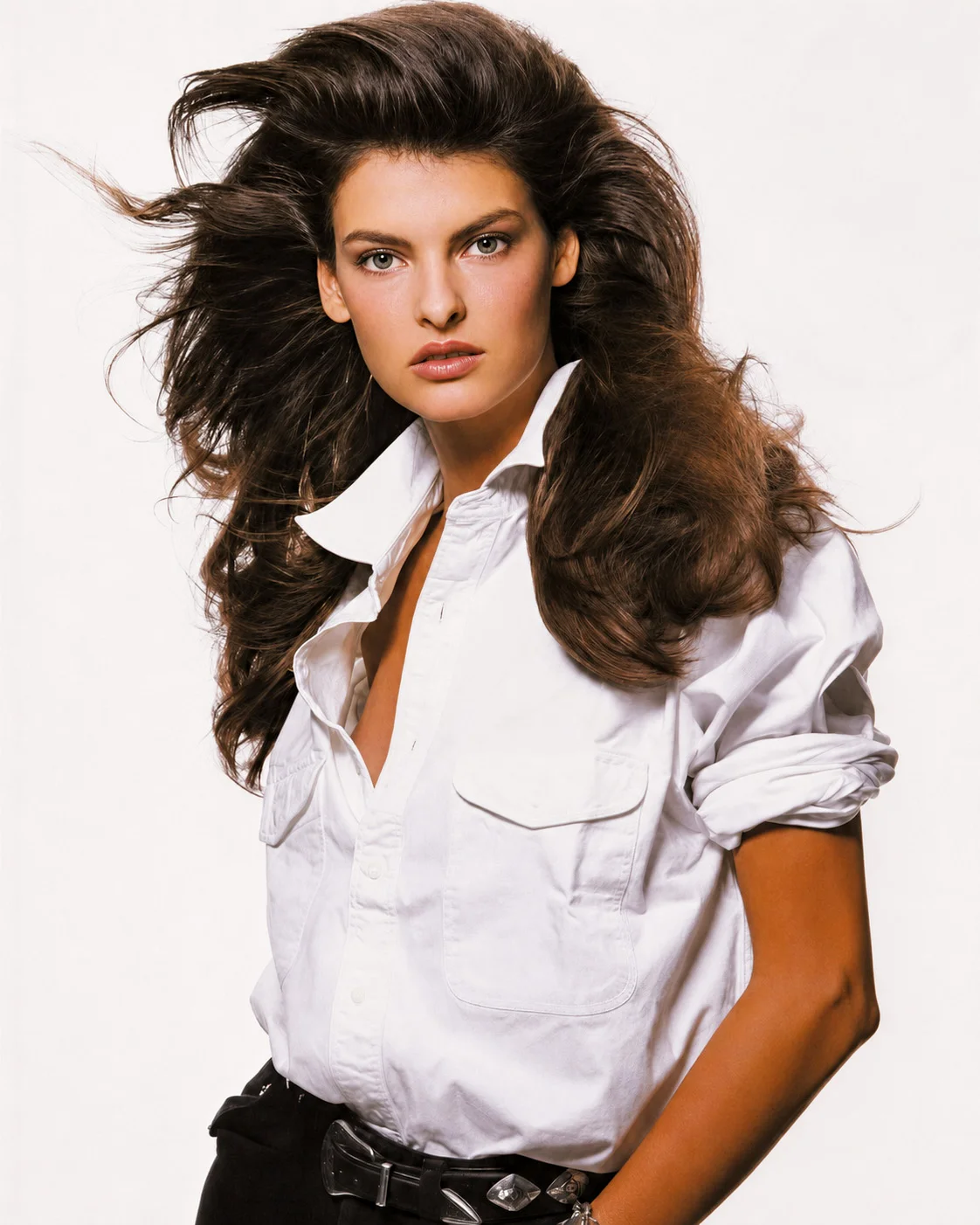
Arthur Elgort booked her for French Vogue, and the momentum finally came; by that magazine’s September 1987 cover she had become a name to book. That same year, at twenty-two, she married Gérald Marie, the man who ran Elite’s Paris office. Versace was about to move her from print onto the runway, a jump few models made then, and one that would eventually put her in Versace’s 1991 finale.
Then, in the autumn of 1988, a short wig turned up on a shoot, Peter Lindbergh liked what it did to her, and told her to cut her hair for real. The photograph here is the last of the long-haired years, a very good model who was almost, but not quite, the most wanted face in the world.
Sources:
-
Linda Evangelista — Wikipedia
-
Linda Evangelista — Interview
-
Linda Evangelista’s Vogue Interview — British Vogue
Filed under Linda Evangelista
This post is timestamped using Blockchain technology. Verify