Spellbound at the End of Amber
In November 1991, Estée Lauder ran a full-page advertisement in American Vogue that broke the house’s usual formula. Instead of a lone woman gazing past the camera, the frame held two people in profile, foreheads almost touching, a man’s hand pushed into a woman’s hair. Across the bottom, in gold Art Deco capitals, sat one word: Spellbound. The tagline promised “the intense magic of falling in love,” and for once the picture tried to show the falling rather than the woman doing it alone.
Lauder in 1991 was not a company that needed to gamble. By some counts it held close to half of the American prestige cosmetics market, a dominance no rival came close to matching. Leonard Lauder, Estée’s older son, was president and chief executive, and he ran the fragrance side on a theory he liked to state plainly: “Our fragrance advertising sold romance and prestige. You can’t sell romance with an anti-wrinkle cream.” Scent, in his telling, was the thing that pulled a woman into the whole Estée Lauder world and kept her buying everything else in it. A year earlier he had hired Robin Burns to run the American business, poaching her from Calvin Klein, where she had grown the cosmetics arm from six million dollars to two hundred million on the back of Obsession and Eternity. She knew exactly how to sell a bottle as if it were a narcotic.
Spellbound arrived on a schedule. Beautiful had launched in 1985 as a bridal bouquet, Knowing in 1988 as a mossy chypre, and Spellbound completed a kind of trilogy, each release a notch more nocturnal than the last. The house was building fragrances the way a studio builds a franchise, and by the early nineties it had the distribution and the trained counter staff to make almost any launch land. What it wanted from Spellbound was heat.
The campaign was willing to be unusually literal about that. You can see it in that near-kiss between the male model Nick Constantino and Julie Anderson, the two of them pressed close in grainy black and white, less a perfume ad than a film still from the second before a kiss. The following year the house swapped Anderson out and put Paulina Porizkova in the woman’s place, the Czech supermodel who had been a face of the brand since 1988. Constantino stayed. The romance survived a change of leading lady.
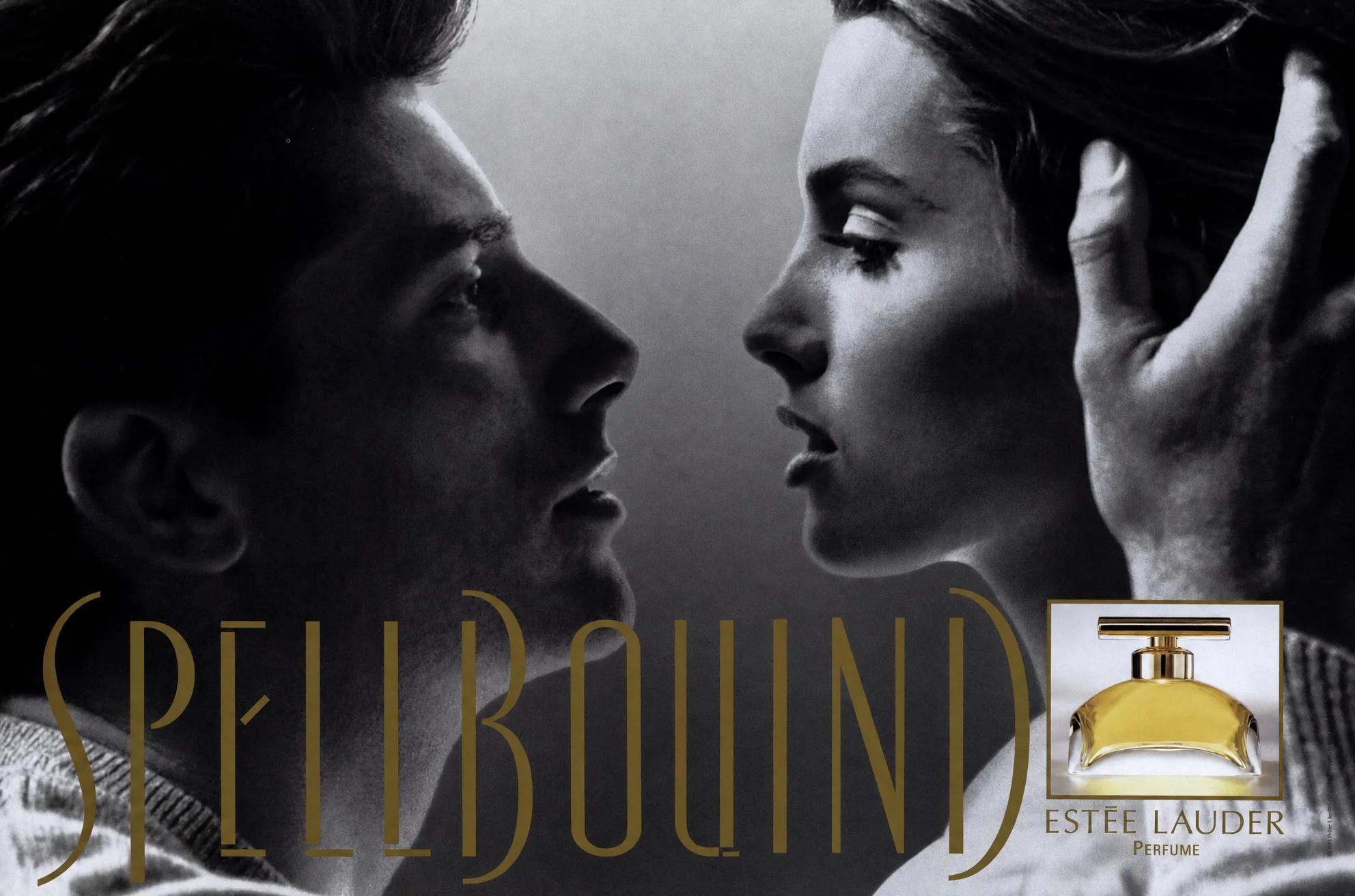
The juice inside the gold bottle earned the drama. Spellbound is an amber-spicy oriental, and it wears like Beautiful after dark: the same floral bones dragged down into warm amber and clove, with a green, almost cold hit of lily of the valley sitting up top. It was loud. It crossed a room and hung there for hours, which in 1991 was the point rather than the problem.
It sold well, and then something more interesting happened to it. A later reformulation thinned the original out, and the people who had loved the first version turned into a small, stubborn resistance, hoarding vintage bottles and warning each other off the new one. That reaction is usually the mark of a fragrance that meant something to somebody. Estée Lauder still sells Spellbound today, though it was pointedly left out of the 2024 Legacy Collection that brought back Azurée, Knowing, White Linen and two others under Frédéric Malle’s supervision. The scents chosen for that revival were the museum pieces; Spellbound, apparently, sits a rung below.
As for influence, I would be careful. Spellbound didn’t start a trend so much as end one. The big spicy orientals had ruled the late eighties, from Opium to Obsession to Coco, and within three years of Spellbound’s launch the market lurched hard the other way, toward the clean nothing of CK One and the aquatics that trailed it. Spellbound reads now like one of the last confident sentences in a language that was about to fall out of use, a powerhouse turning up just as powerhouses stopped being wanted. Its real legacy is smaller and more durable than a trend: a reference point perfume people still reach for when they need to describe what warm, spiced amber is supposed to smell like.
Sources:
-
SpellBound Eau de Parfum Spray — Estée Lauder
-
SpellBound by Estée Lauder — Fragrantica
-
The Estée Lauder Companies Inc. — Encyclopedia.com
-
Learning from Estée Lauder’s Leonard Lauder — Investment Masters Class
-
Estée Lauder’s Legacy Collection — The Zoe Report
Filed under Fragrance
This post is timestamped using Blockchain technology. Verify