A Thousand Pools Since 2010
The headline figure has been reported as more than a thousand publicly accessible pools closed across the country since 2010, with around forty-two per cent of those losses falling after 2020 alone. The acceleration is the part of the statistic that tends to get skipped. A slow attrition would suggest a shift in habits. A cliff means something else was paying for these buildings, and that something stopped.
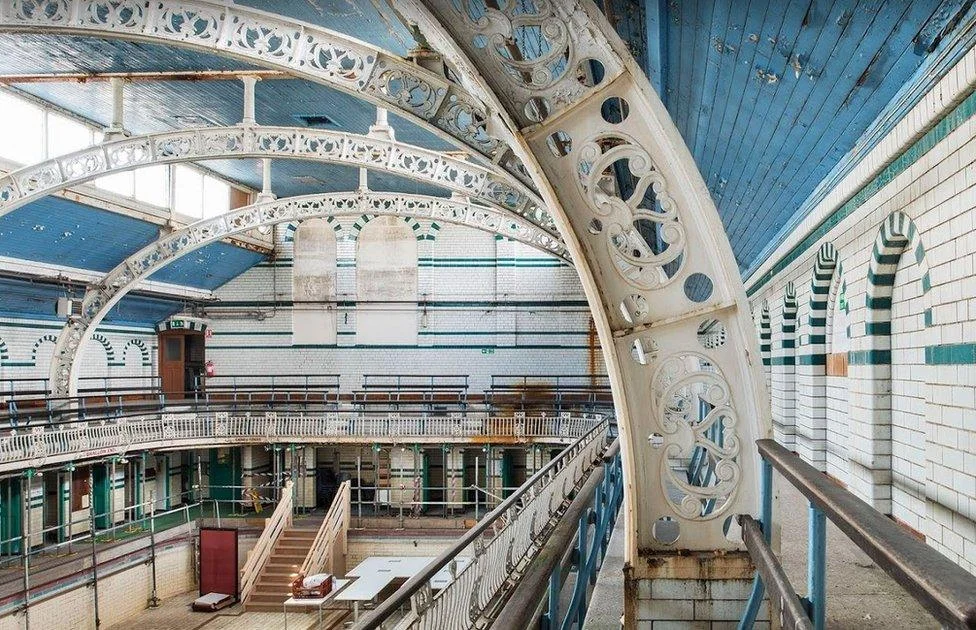
The pools in question were rarely ordinary. Britain accumulated an unusual stock of municipal swimming infrastructure over a century and a half, and the Edwardian and inter-war buildings were architecturally ambitious in a way no leisure-trust replacement ever attempts. Moseley Road Baths in Birmingham opened in 1907 and has kept its swimming function essentially continuously since, which is rare for the period. It still has its forty-six original slipper-bath cubicles, the oak ticket offices and attendants’ kiosks, and what may be the last steam-heated drying racks left in a British pool. That is a description of a building that was designed to do work most people no longer remember asking of a pool.
Slipper baths held the line. Households without indoor plumbing rented a private bathtub at the baths by the half-hour, with the towel and soap included on the higher tariff. The municipal pool was therefore not a sports venue grafted onto a town. It was the hygiene infrastructure, the lido in summer, the gala hall on Saturdays, and the cheap warm room for women allowed in on segregated days. When that function went, the buildings stayed.
The closures concentrate where the buildings did most of that work. Swim England’s analysis found a hundred and sixty-nine pools lost in the most deprived parts of the country against forty-nine in the richest, and seventy per cent of the worst-affected local authorities fell above the average for multiple deprivation. The losses are not distributed across the map. They are tracing the same outline that council tax bases trace, that bus deregulation traced, that the post-PFI maintenance backlog traces.
Fifteen hundred more pools are over forty years old now, according to the same data, and considered to be reaching the end of their useful life. That figure carries the next decade inside it. A boiler from 1978 cannot indefinitely be coaxed back into compliance with whatever the current edition of the water-treatment regulations says. Either the council finds the capital to replace the plant, or the pool closes on a Friday afternoon and never reopens.
What is left in the closed buildings is harder to describe than the arithmetic. Drained pools hold their acoustics for a surprisingly long time. The tile lines, the diving stages, the numbered changing cubicles all survive the absence of water without obviously deteriorating, and the chlorine smell lasts in the grouting after the ventilation has been turned off for years. The first time you walk into one of these spaces empty, the strangeness is not the silence. It is that nothing about the room admits that anything has changed.
The pool buildings were never really about sport in the way the arithmetic of pool-closure reporting now implies. They were about a particular version of public provision, indoor heat that did not depend on whether your boiler at home was working, water that the council was responsible for keeping clean. We are not really losing swimming, which can be done in a private gym or a glassy hotel basement for a fee. We are losing the proposition that a town owes its residents a warm room with a roof on it, paid for in advance out of the rates. The buildings survive longer than that proposition does, which is what makes walking past them in 2026 a particular kind of unsettling.
Sources:
-
Thousand pools shut since 2010 — LocalGov
-
Pace of pool closures increasing warn Swim England and ukactive — Swim England
-
Moseley Road Baths, Birmingham — Historic Pools of Britain
Filed under Hauntology & the uncanny
This post is timestamped using Blockchain technology. Verify