Darkness, Translated
The English translation of In Praise of Shadows appeared in 1977, published by Leete's Island Books with a foreword by the architect Charles Moore, who wrote that the essay "could change our lives." By the mid-1980s it had become something very specific: the canonical text Western designers and architects reached for when they wanted theoretical cover for dimmer rooms. This is not a complaint. It is just an accurate description of what happens when an essay written in Japanese in 1933 crosses into a culture that is, at that exact moment, running out of patience with the Modernist interior.
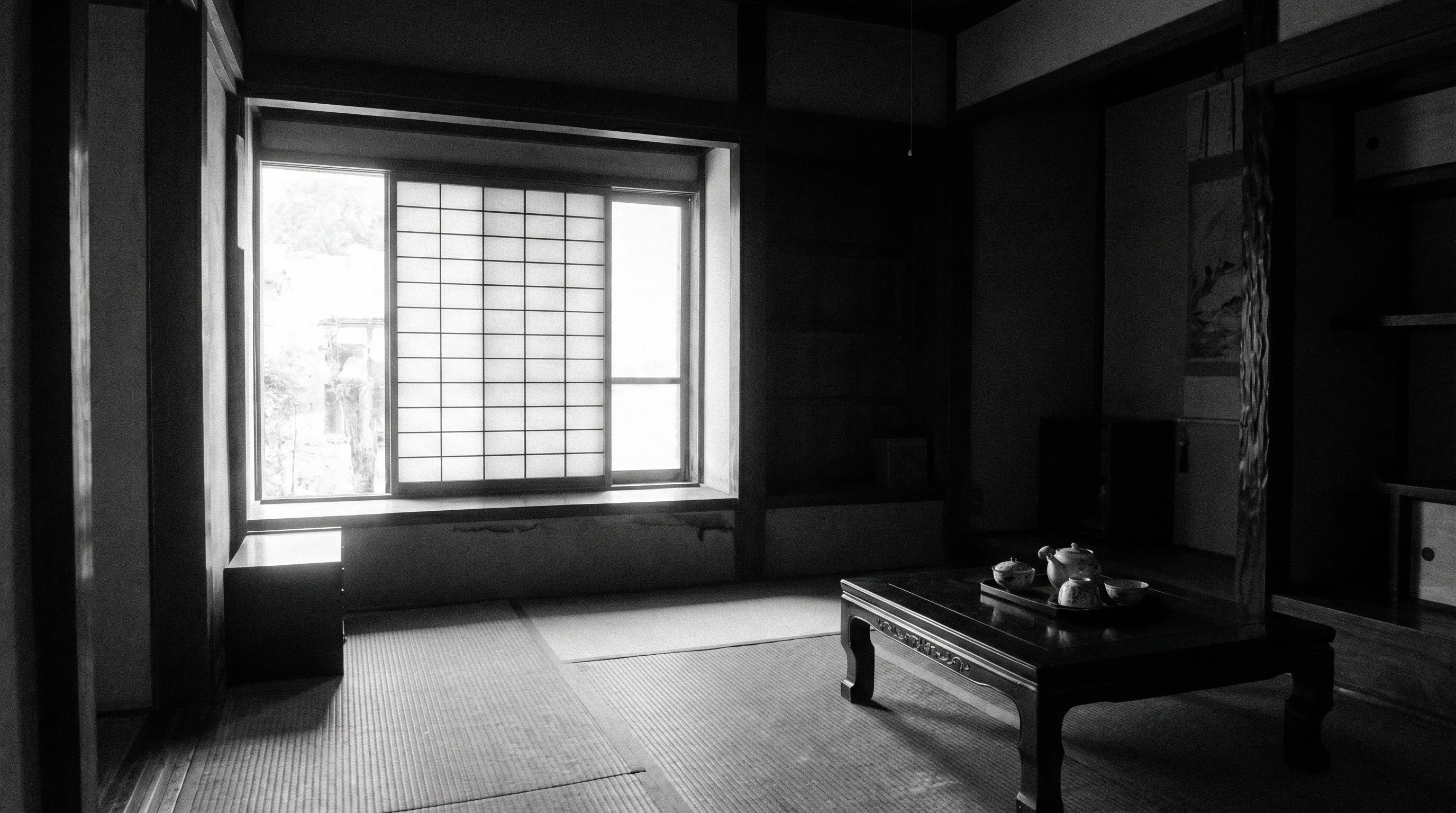
Tanizaki's argument is simple enough in outline. Japanese architecture organises itself around shadow. The deep roof overhang of a traditional house keeps the interior dim. Lacquerware, gold embroidery, cloudy paper, their beauty depends on low light, on the way darkness lets a material breathe without the scrutiny of full exposure. Westerners, he argues, are congenitally committed to brightness: from candle to oil lamp to gaslight to electric light, their progress is a history of abolishing shadow wherever it pools. Japanese culture accommodated the dark. Western culture declared war on it.
What made this legible to an 1980s Western audience was partly timing. The translation arrived just as postmodern architecture was trying to argue its way out of the glass box. Moore himself was building Piazza d'Italia in New Orleans. The appetite for any text that questioned the clean-bright-functional dogma was considerable. Tanizaki, dead since 1965 and safely historical, offered an aesthetic that could be absorbed without political risk, and the quality he described, that particular stillness of a dim room with tatami underfoot and light filtered through shoji, landed precisely where Western designers needed it to land.
The irony that the 1980s West almost entirely missed is geographic. The same decade that architects were annotating their copies of In Praise of Shadows, Tokyo was building the city that inspired Ridley Scott's Blade Runner. Japan had become the global centre of consumer electronics: Sony, Honda, Sharp, the robotics movement, a neon-saturated culture that made the Pacific Rim feel like a preview of everywhere else's future. Tanizaki's 1933 elegy for pre-modern shadow had become, within fifty years, a description of the very country that had most completely abandoned what he mourned. Western readers, discovering the essay in translation, were perfectly positioned not to notice.
There is also a reading problem the 1980s West missed almost entirely. Tanizaki was not writing a sincere treatise. He was writing a zuihitsu, a Japanese prose form that permits fiction, irony, and digression, using a narrator who ventriloquises the tropes of cultural superiority that circulated freely in 1930s nationalist Japan. The essay's reader in 1933 Japan understood this. The Western reader in 1985, lacking that context, took the East/West binary at face value, lifted it into their own anti-modernist argument, and used it as evidence.
This is what the essay became in Western hands: permission. Permission to use wood instead of aluminium. Permission to keep a room dim. Permission to frame slowness and imperfection as values rather than deficits. All of that was probably overdue. I am not sure the fact that Tanizaki was doing something more complicated invalidates it entirely, you can extract something real from a text even when you misread it, and what the West extracted was genuinely useful. But the book it drew from is odder and funnier than the version it invented. Tanizaki admits he cannot give up electricity. He praises a toilet as a place for quiet contemplation and then spends two paragraphs on miso soup. The serene, quietly authoritative In Praise of Shadows that entered Western architectural thinking in the eighties is cleaner than the original, which is messier and considerably more entertaining.
Sources:
-
In Praise of Shadows — Wikipedia
-
Performance of East-West Discourses in Tanizaki's "In Praise of Shadows", Néojaponisme
-
The World of Jun'ichirō Tanizaki: In Praise of Shadows, New Intrigue
Filed under Books & writing
This post is timestamped using Blockchain technology. Verify