Still Life with Slingback
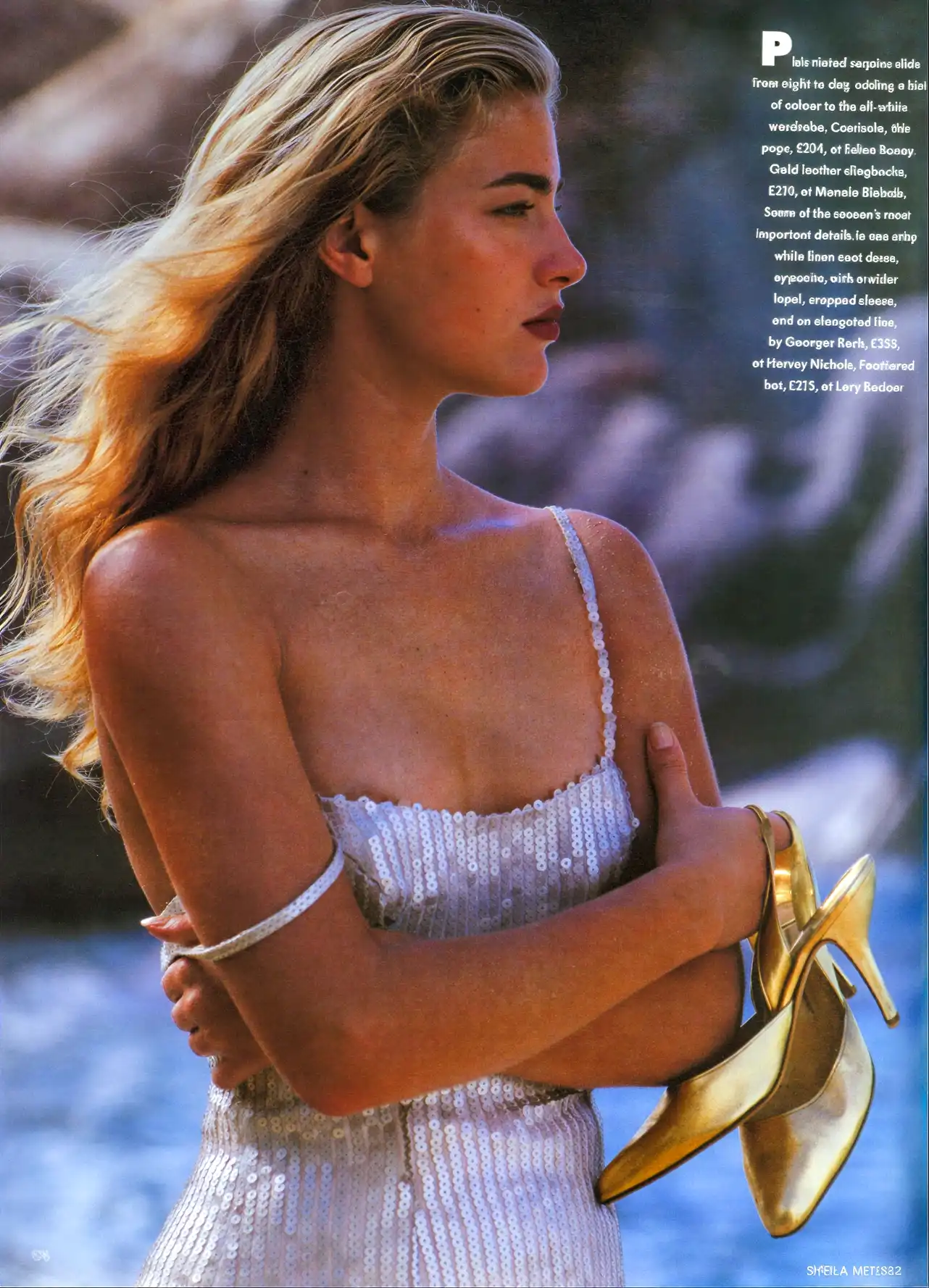
Gold slingbacks held against a white sequined dress, water blurring behind. Elaine Irwin at twenty-one, hair thrown forward by wind rather than water, the whole frame lit as if the light itself had aged a century.
The editorial ran in British Vogue, April 1991, under Liz Tilberis: "Finest Luxuries of High Summer Dressing." Sheila Metzner took the pictures. She printed them, as she did by then with everything, on Fresson quadrichromie: a slow charcoal-pigment process developed in 1899 and kept alive one generation at a time by a single family of printers outside Paris. The technique breaks every image into granular pigment fields. It makes fashion look less like fashion and more like memory.
Metzner's American Vogue contract had ended by the late 1980s. By the spring of 1991 she was working British Vogue for Tilberis, who was simultaneously engineering the supermodel decade out of her Hanover Square office. The commission fits oddly in that plan. Tilberis's Vogue was a magazine of movement and personality. Metzner's pictures are a magazine of stillness.
Irwin is not smiling, not performing, not selling. She's holding the shoes like an offering, forearm braced against the sequins, the sun catching them from the upper right. The copy block in the top corner lists the pieces in bureaucratic order: Manolo Blahnik, Harvey Nichols, Georges Rech. The pictorialist treatment transforms the stockists into something close to provenance.
Critics hated this mode. Keith Seward, writing for Artforum, questioned Metzner's claim that photography carried more truth than painting: the pointillist grain of Fresson print, he suggested, was pictorialist cover for commercial conservatism. Nearly three decades later, reviewing her 2023 Getty retrospective in the same magazine, Hal Foster went further, the mode had become "regressive," the technique "barbarous," the work "evidence of our artistic narcissism." Every word earned against the grain.
And yet the editorial holds, because it doesn't want to belong to its moment. The Third Summer of Love had already run in The Face. Corinne Day photographing a teenage Kate Moss on a Camber Sands beach. That was the image the early nineties were supposed to become. Metzner was producing something close to its opposite. High luxury, classical pose, sequin and gold. If Day's Kate was the forward wave, this was the undertow: a magazine page that wanted to be a memory before it was finished printing.
Sources:
-
Keith Seward on Sheila Metzner — Artforum
-
Hal Foster on Sheila Metzner — Artforum
Filed under Elaine Irwin
This post is timestamped using Blockchain technology. Verify