Mauves and Purples and Steely Grey
Trunk Records specialises in the kind of music that shouldn't exist any more. Library scores. Forgotten soundtracks. Tapes found in attics. In 2023 they released a 26-track LP compiled from the private archive of Elizabeth Parker, a composer who spent eighteen years at the BBC Radiophonic Workshop and never released a solo record. The album is called Future Perfect, and it sounds like receiving a transmission from a building that was demolished thirty years ago.
Parker joined the Workshop in 1978, studied under Tristram Cary on the EMS Synthi 100, built special sound for Blake's 7 using a VCS3, and scored David Attenborough's The Living Planet on a PPG Wave 2.2 that was one of only two in the country. The other belonged to the Pet Shop Boys. She completed over 1,400 commissions for television and radio. When the Workshop closed in 1998, she handed in her key and walked out in tears. Nobody from management came to say goodbye.
None of that is on this record.
Future Perfect is the work Parker made for herself. No commissioner. No brief. Four decades of tape loops, field recordings, and synthesiser experiments that sat in boxes because nobody asked for them. She described the palette as "mauves and purples with the occasional flicker of steely grey," which is the most precise description of a colour temperature I've encountered in liner notes.
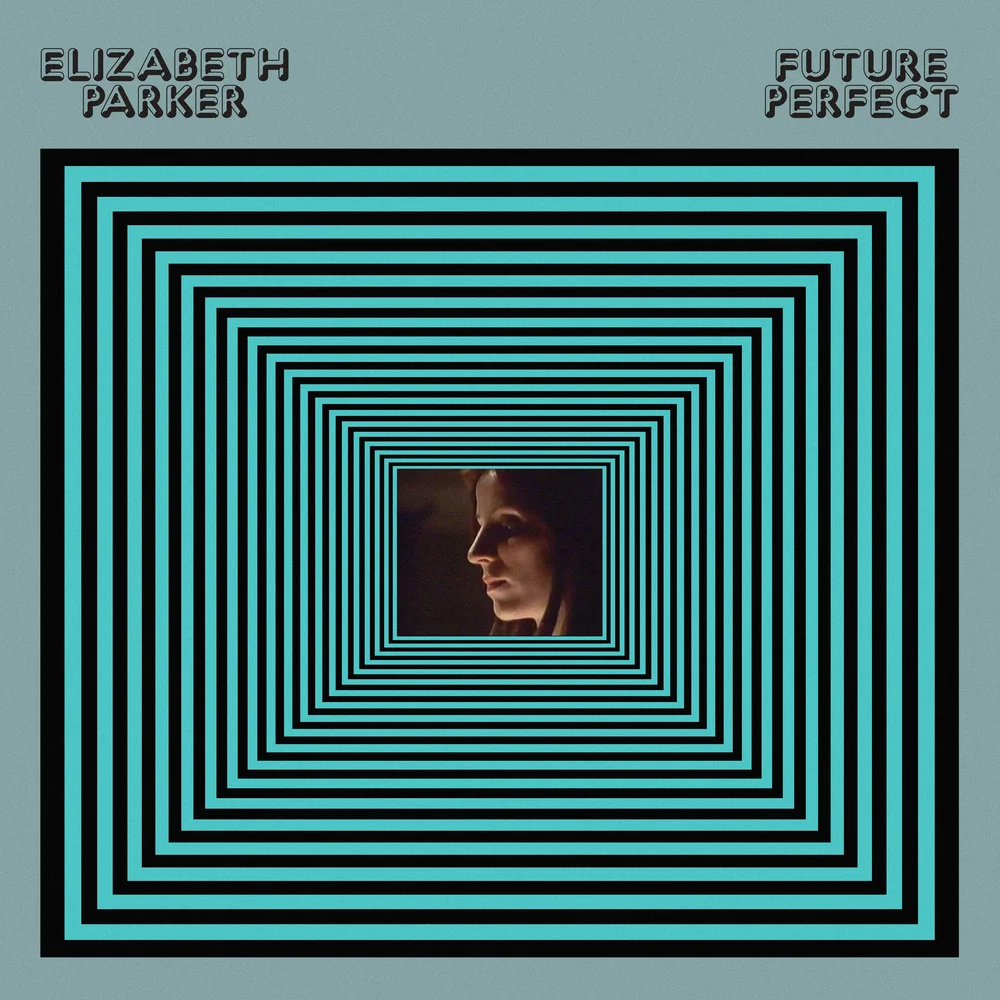
The artwork gets it right: concentric rectangles collapsing inward, a face half-visible at the centre, teal on black. A signal in decay.
The tracks range from "Ghost In The Abbey," which buries ecclesiastical voices under enough reverb to fill an actual nave, to "Fish Don't Cry," which is industrial cassette noise of the kind that would have circulated on a C60 in 1983 and never surfaced again. Robin Tomens compared "Siren-Call" to Ligeti's Lux Aeterna. The title track bruises baroque and jazz motifs with jump cuts that feel genuinely hostile. Parker recorded boat wires humming in a Cornish harbour, scaffolding rattling during house renovations, and fed all of it through voltage. Physical objects vibrating into microphones, processed by machines that are themselves now obsolete.
The obvious context is hauntology. Ghost Box Records, Belbury Poly, Pye Corner Audio, the entire analogue revival builds new music from the aesthetic vocabulary of the Radiophonic Workshop. What makes Future Perfect disorienting is that it isn't a pastiche of that vocabulary. It is the source material. Simon Reynolds included it in his Hauntology Parish Newsletter, calling it "a very nice compendium," then wondered whether the genre itself was "a teensy bit on the late side." He conceded the irony immediately: hauntology by definition would not shuffle off punctually. It would malinger, fixated on the same totems.
Delia Derbyshire told Parker at a party in the early 1980s that she wanted to "hand over the baton." They kept in touch for years but never collaborated. Parker has described herself as "an afterthought" to Workshop history, and the archival record more or less confirms it. Derbyshire gets the documentaries. Daphne Oram gets the retrospectives. Parker's private tapes sat unheard until a reissue label specialising in exactly this sort of cultural recovery came looking.
I keep thinking about the PPG Wave 2.2. Parker used it to score a nature documentary that was nominated for an Emmy. Then she took it home and made music that nobody would hear for forty years. Same hands, same machine, same voltage running through the same circuits. One version became famous. The other sat in a box. The instrument didn't know the difference.
Sources:
-
Elizabeth Parker, Future Perfect and the BBC Radiophonic Workshop - The Haunted Generation
-
Elizabeth Parker: The Last Post - Electronic Sound
-
Elizabeth Parker: Flexible Working - Sound On Sound
Filed under Music
This post is timestamped using Blockchain technology. Verify