Cold Fusion in Dorset
In 1981, the guitarist from the biggest band in the world drove to a small studio in Parkstone, Dorset, to make a record his label actively did not want him to make. Andy Summers had known Robert Fripp since their teens in Bournemouth. They'd kept in touch through the decades, jamming occasionally, circling something neither had quite articulated. With The Police between Ghost in the Machine and Synchronicity, and Fripp reconvening King Crimson for the Discipline trilogy, a window opened. Summers booked a week at Arny's Shack, a studio run by an engineer named Tony Arnold who smoked a pipe while he recorded, with further sessions at Island Studios in London. Fripp joined for the second week. They made it up as they went.
The result, I Advance Masked, came out in October 1982 on A&M Records, the same label that had tried to kill it. "The label didn't want me to do it," Summers told Louder Sound in 2025, "but didn't want to piss me off." The album reached number 52 on the Billboard 200, where it spent eleven weeks. For a wholly instrumental record built on guitar synthesisers and tape loops, that was, in Summers' words, "the ultimate FU to the record company."
What makes the album strange, and what keeps it interesting forty-three years later, is how little it resembles either musician's day job. This isn't The Police plus King Crimson. The Neuguitars Substack called it "a cold fusion of two very distinct and mutually opposed sounds", which gets at the chemistry without overselling it. Fripp laid down polyrhythmic lines in odd metres, using his Frippertronics tape loop system to build layered, self-decaying textures. Summers described Fripp's parts as "the bones of a piece," onto which he'd graft harmony chords, guitar synth washes, and the occasional bluesy solo that wandered in from some other record entirely.
The Frippertronics technique deserves a moment here, because it's central to why these records sound the way they do. Two Revox reel-to-reel decks, spaced apart. Tape travels from the supply reel of the first to the take-up reel of the second. Sound records on one, plays back on the other, feeds back to the first. Delays of three to six seconds, decaying gradually, building loops in real time. Terry Riley pioneered the method in 1963. Pauline Oliveros expanded it. Fripp encountered it through Brian Eno during the No Pussyfooting sessions in 1972 and made it his own. On I Advance Masked, you hear it most clearly on "Under Bridges of Silence" and "In the Cloud Forest," tracks where the technique creates something closer to weather than music, atmospheric systems that shift and resettle.
I keep returning to this: Frippertronics is a palimpsest machine. Every new phrase writes over the last, but the last never fully disappears. It degrades, blurs, becomes a ghost of itself while the next layer takes its place. The loops don't erase; they haunt. If you wanted to design a technology purpose- built for hauntological sound, for music that carries the residue of its own past within it, you'd struggle to improve on two tape decks and a length of quarter-inch tape.
Nobody has written the hauntological reading of these records, which surprises me. The raw material is sitting right there. The guitar synth timbres on I Advance Masked instantly date the album to 1982, the same way that a BBC Radiophonic Workshop piece dates itself to its decade through the technology available. But the compositional thinking, the textural ambition, points somewhere else, somewhere that hadn't arrived yet. The albums occupy a temporal crack: too experimental for Police fans who wanted "Every Breath You Take," too pop-adjacent for the avant-garde who dismissed anything on a major label. They fell between audiences, between eras, between the identities of the men who made them. That kind of commercial orphan status is exactly where hauntological objects tend to reside, in the margins where culture forgets to look.
The criticism of I Advance Masked is real and worth acknowledging. The Moving the River review is blunt: "under-produced, tentative and unfinished-sounding." The drum programming is limp. The bass playing is, charitably, amateurish. These were two guitarists playing everything themselves, and it showed. The shorter ambient pieces lack coherence, drifting without arriving. But I think the roughness is part of what makes the album age well. Polished records from 1982 sound like 1982. Rough ones sound like drafts from a future that didn't quite materialise, which is more or less the definition of hauntology.
Bewitched, released in 1984, is a different animal. Summers had a clearer sense of how to work with what he called Fripp's "idiosyncratic genius," and the album brought in session musicians: Sara Lee on bass, who'd played in both Gang of Four and Fripp's own League of Gentlemen, real drums, actual song structures. The result is more conventional and, track for track, more consistent. "Parade" opens with New Wave percussion and a synth-guitar melody that evokes Bowie's Low. "What Kind of Man Reads Playboy?" layers wah-funk, harmonic textures, bebop, and blues into something Moving the River called "a perfect distillation of the state of the electric guitar in the mid-'80s." Side one of Bewitched is genuinely excellent.
Side two is not. Multiple reviewers note the drop-off: short, poorly recorded tracks that sound like outtakes rather than finished pieces. Fripp himself acknowledged the shift in balance: "The album is a lot more Andrew than it is me." He'd assumed a deliberately recessive role, providing textural framework rather than competing for the spotlight, and some critics found this admirable but disappointing. The locked-room intimacy of the debut, two guitarists and their machines, had been traded for something more produced but less distinctive.
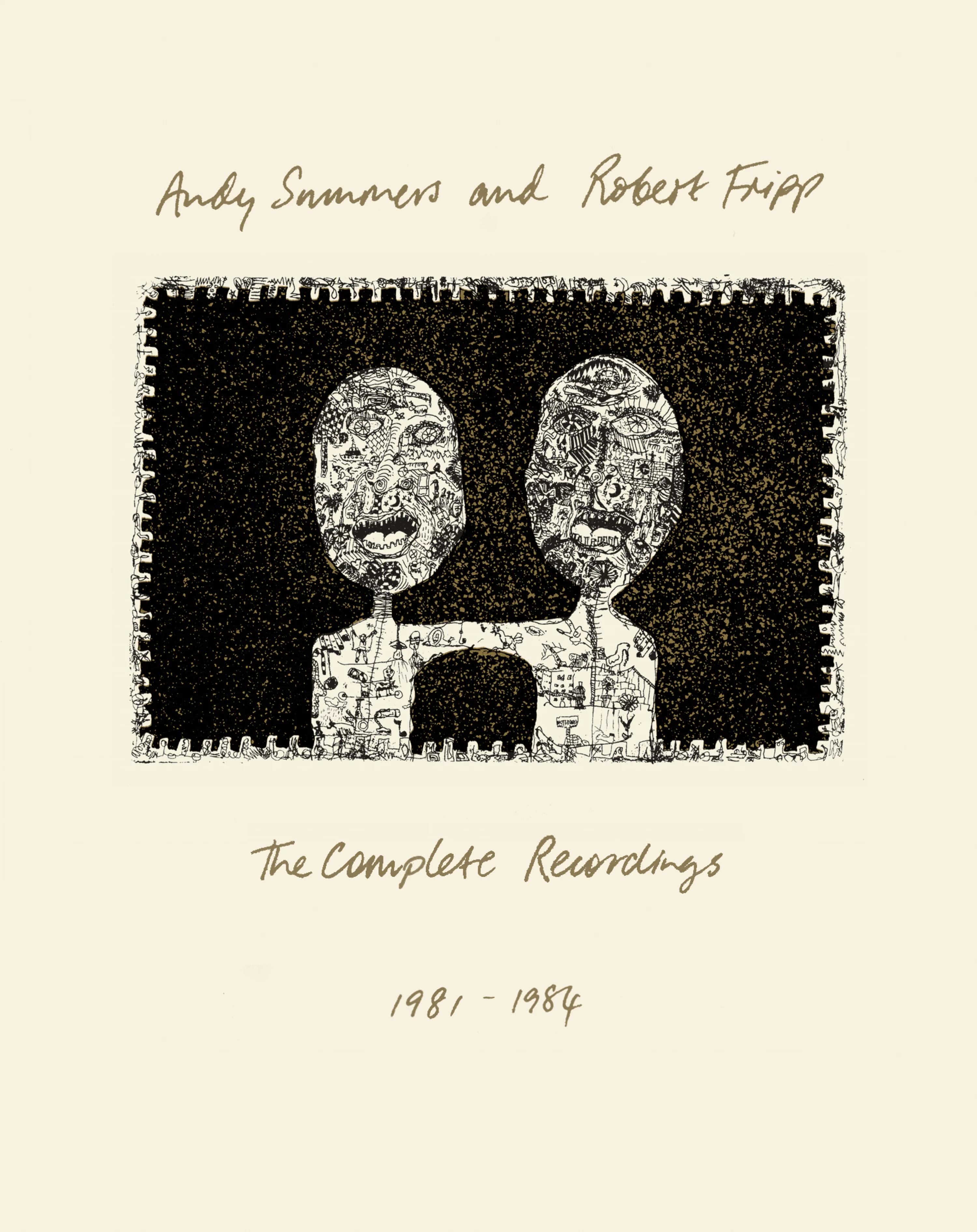
What sits between these albums now, in 2025, is a literal ghost. During preparation for a Complete Recordings 1981-1984 box set on DGM/Panegyric, Summers found four tape reels in a Los Angeles vault. Thirteen tracks. Enough for a full album, titled Mother Hold the Candle Steady and newly mixed by David Singleton. "I was sort of shocked that we had never used them," Summers said. The tapes had been gathering dust for forty years.
A lost album, discovered by accident, assembled decades after the fact from material that was never intended to be heard. If the original two records were ghosts of a future that didn't arrive, Mother Hold the Candle Steady is something stranger: a past that didn't happen, recovered and presented as though it always existed. The box set also includes "Can We Record Tony?," an audio documentary assembled from Fripp's archival cassettes of their earliest improvisations, sessions so preliminary they barely qualify as recordings. These are signals from before the signal, pre-echoes.
Summers and Fripp lost touch entirely after Bewitched. "Our lives just shot off in different directions," Fripp said. There is something fitting about that, two musicians who made spectral, time-displaced music together, then vanished from each other's lives completely, leaving behind a body of work that sounds increasingly out of its own time. The albums aren't nostalgic. They aren't period pieces. They exist in a space that Summers, in a 2025 Guitar Player interview, described with more accuracy than he probably intended: "It was a time when you could still pull off new stuff that people really hadn't heard yet." That sentence carries a quiet grief for the moment it describes. A time when new stuff was still possible. A future that was still open.
The Neuguitars writer admitted to entering what they called "a hauntological, nostalgic, middle-aged phase" while listening to the reissues, and I think that's honest in a way that most music criticism isn't. These records don't just sound like the early 1980s. They sound like what the early 1980s thought the future would sound like, played on instruments that now feel as analogue and irretrievable as a reel of quarter-inch tape feeding through two Revox decks in a shack in Dorset.
Sources:
-
Andy Summers and Robert Fripp Collaborated with Remarkable Ease — Louder Sound
-
Andy Summers and Robert Fripp: That Clever, Dynamic Duo — Neuguitars
-
Two Guitar Telepathy Take 2 — Moving the River
-
Andy Summers + Robert Fripp: I Advance Masked — Post-Punk Monk
-
Complete Recordings 1981-1984 — The Second Disc
-
Andy Summers on His Robert Fripp Collaboration — Guitar Player
-
Early Tape Loop Experiments — Valhalla DSP
Filed under Hauntology & the uncanny · Music
This post is timestamped using Blockchain technology. Verify