Carla Bruni at the Ritz Pool
On January 20, 1996, Gianni Versace presented his Atelier Spring/Summer collection at the Hôtel Ritz in Paris. Not in a ballroom. Not in a convention hall. In the swimming pool. He'd been showing couture there since 1990, boarding over the water and transforming the space into something that felt less like a fashion venue and more like a private theatre built for three hundred and fifty people who already understood the plot.
That season he carpeted the pool in black bordered with acidic yellow. Models descended curling double staircases at the back of the runway, sometimes two at a time in mirrored formation. The architecture of the presentation mattered to Versace as much as the clothes. He understood that couture isn't just about construction — it's about the moment the construction becomes visible.
Carla Bruni in a yellow beaded gown, hand at her hip, the black and white checkerboard floor falling away behind her — and you can see immediately why Versace kept casting her. There's a stillness in Bruni's runway work that most models don't attempt. Where others project energy outward, she holds it close. The dress is spectacular — hand-beaded embellishment catching light from every angle, the kind of surface detail that only makes sense at couture scale — but Bruni wears it like she's thinking about something else entirely. That tension between excess and restraint is pure Versace. He built his house on it.
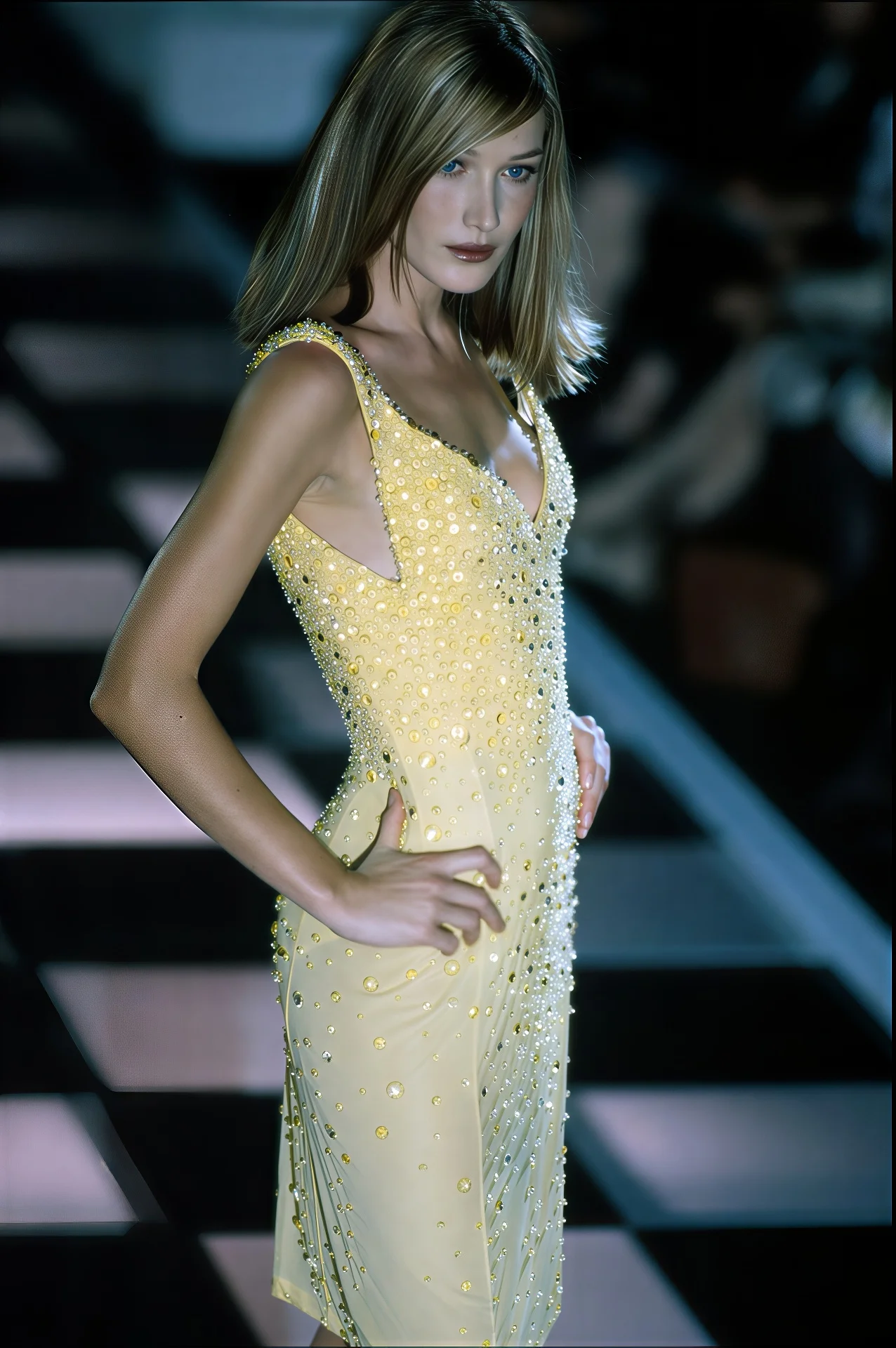
By 1996 Bruni had been modelling for nearly a decade. She'd walked for Chanel, Dior, Givenchy, Yves Saint Laurent, Valentino, Lacroix — everyone who mattered. She'd appeared on over two hundred and fifty magazine covers. She was among the twenty highest-paid models in the world. But her relationship with Versace was different. She was one of his key muses, present at nearly every show from 1990 onward, and the collaboration defined something specific about the era: the moment when supermodels became co-authors of the work rather than vehicles for it.
The Ritz pool itself tells part of this story. Built in 1987 during a two hundred and fifty million dollar renovation, its design drew from ancient Greek and Roman baths — which made it an almost too-perfect match for Versace's classical obsessions. The Medusa logo, his most enduring symbol, came from that same well of mythology. He chose it because, as he explained, anyone who looked at Medusa had no choice but to fall in love. Whether he was talking about the logo or about the women wearing it was never entirely clear.
The Spring/Summer 1996 collection marked a subtle shift. The heavy Baroque maximalism of earlier seasons was giving way to something more nuanced. The metallic fabrics were still there — Versace had invented his own chainmail textile, Oroton, back in 1982 — but the tones were quieter, the classical references more direct. Greek vestals instead of Byzantine emperors. The embellishment remained extraordinary but the silhouettes were leaner, more assured. This was a designer approaching the refinement phase of his vision, stripping away everything that wasn't load-bearing.
Naomi Campbell walked the same show in a black lace and zebra-striped dress with a feather in her hair. Karen Mulder was there. Helena Christensen. Valeria Mazza. Stella Tennant. Sting and Trudie Styler watched from the front row. The original supermodel generation was cresting — still dominant, still defining what glamour looked like — but the ground was shifting beneath them. Kate Moss and the rise of heroin chic were rewriting the rules in real time. Calvin Klein's gaunt, androgynous aesthetic stood in direct opposition to everything Versace believed about the body, about celebration, about the purpose of clothes. His shows were among the last places where unapologetic supermodel glamour wasn't just tolerated but required.
Eighteen months after this collection, Gianni Versace was murdered on the steps of his Miami mansion. His final couture show — presented at the same Ritz pool on July 6, 1997, nine days before his death — was dominated by black and weighted with Byzantine religious symbolism. Oversized jeweled crosses. Silhouettes that echoed nun's habits rendered with his signature body-conscious precision. Whether he sensed something ending or whether that reading is purely retrospective, the contrast with Spring/Summer 1996 is striking. The earlier collection still has daylight in it.
Bruni retired from modelling in 1997 as well, turning to a music career that would eventually lead to a completely different kind of public life. This photograph captures her in the narrowing window between peak visibility and departure — not just from the runway, but from the version of fashion that the runway represented. The supermodel era didn't end with a single event. It eroded gradually, season by season, as the industry moved toward a different set of values. But moments like this one — Bruni in Versace at the Ritz, the beading catching the light, the pool hidden beneath the floor — are where you can still see what the fuss was about.
The dress outlasts the show. The photograph outlasts the dress. What doesn't survive is the specific quality of attention in the room when three hundred and fifty people watched Carla Bruni descend a staircase above a swimming pool and understood, without anyone having to explain it, that they were seeing something that wouldn't come around again.
Filed under Versace · Carla Bruni
This post is timestamped using Blockchain technology. Verify