The Light That Was Already a Memory
Sodium vapour light had a particular trick. It didn't just illuminate a street — it replaced it. Everything under those lamps became the same deep amber-orange, a colour so dominant it overrode the actual world with a monochrome version of itself. Reds vanished. Blues turned grey. Skin took on a tone that belonged to no living complexion. You could stand on a pavement at ten in the evening and feel like you were already looking at a photograph of yourself standing there.
The UK ran on this light for decades. Low-pressure sodium, mostly — emitting that narrow wavelength around 589 nanometres. Councils chose them because they were cheap and efficient, not for the aesthetics. But the aesthetics is what stuck. If you grew up in Britain between roughly 1970 and 2010, every memory of nighttime carries that cast. Every walk home from school in winter. Every car park. Every breath of condensation under a lamppost outside a shop you've since forgotten.
There's a photograph of Park Street in Bristol, late 1980s, that captures it exactly. The Mauretania pub glowing red through the sodium haze, Averys beneath, the Wills Memorial Building dissolving into mist at the top of the hill. Light trails from passing cars streak down the slope like something being poured. Every surface baptised in that single, overwhelming wavelength.
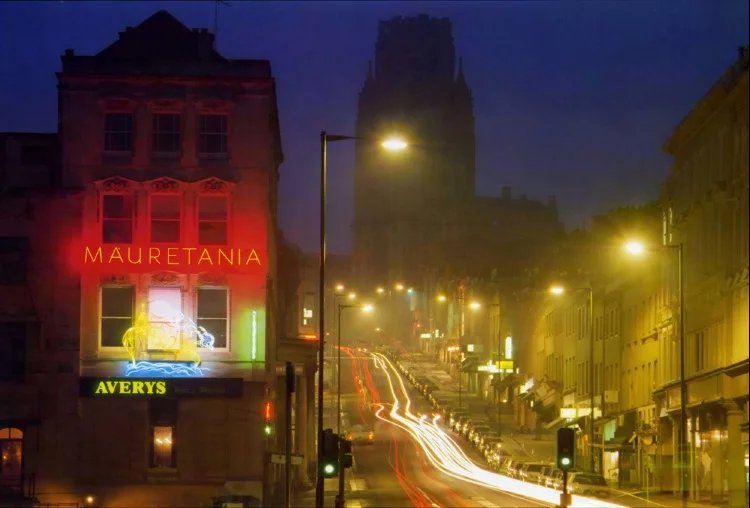
What made it strange — and this is hard to convey to anyone who didn't stand under it — is that the light felt temporary while it was happening. Not because anyone predicted its removal. Because there was something inherently melancholic about how it flattened the world. A row of shops, a residential street, a car park — all of it looked like a memory even while you were standing in it. The scene was fading as you watched.
Since around 2015, councils across Britain have been systematically replacing sodium with white LED. The old colour is nearly gone. When you see it now in photographs or footage, the response isn't nostalgia exactly — it's more visceral than that. That light is the past. The colour no longer exists on any street you can walk down. It has become an artefact in itself, as vanished as the world it illuminated.
Hauntological light. Already ghostly when it was real. Now it's the visual signature of an entire lost era — an amber wavelength that belongs to no living night.
Filed under Hauntology & the uncanny
This post is timestamped using Blockchain technology. Verify